WhatsApp: +8615665767071 Email: info@eworldmachine.com
 English
Views: 0 Author: Site Editor Publish Time: 2026-10-14 Origin: Site
Upgrading factory equipment requires balancing the immediate need for higher throughput against the realities of capital expenditure and facility readiness. Selecting the wrong equipment leads to one of two costly outcomes. You might over-invest in complex technology that your production volume cannot support. Alternatively, you might under-invest in manual-reliant systems that create bottlenecks, increase material waste, and cause missed production deadlines. This guide provides a technical evaluation of CNC (Computer Numerical Control) and semi-automatic glass cutting architectures. We compare these systems across accuracy, material adaptability, and implementation risks. Plant managers can use this data to make an evidence-based procurement decision that aligns with their specific production demands. We break down the mechanical differences, software integration requirements, and facility upgrades needed to support each system on the factory floor.
Production Volume vs. Complexity: CNC systems excel in high-mix, high-volume environments requiring complex geometric cuts, while semi-automatic systems are highly efficient for standardized, straight-line batch processing.
Material Yield: CNC machines natively integrate with automatic typesetting and nesting software, significantly reducing glass scrap compared to semi-automatic methods.
Operational Readiness: Semi-automatic machines require less specialized operator training and have lower facility infrastructure requirements, offering a faster path to deployment.
Table of Contents
Before purchasing new equipment, identify existing glass cutting production bottlenecks, such as slow processing speeds, high breakage rates, or limited shape-cutting capabilities. Evaluate daily output, cutting accuracy, and downstream production delays to determine the capacity and automation level your factory requires.
Glass cutting machine selection depends on the materials processed. Standard float glass, laminated glass, and Low-E coated glass require different cutting pressures and handling methods. Thicker glass needs suitable scoring wheels and breakout systems, while sensitive coatings require careful handling to prevent surface damage.
Glass cutting optimization helps manufacturers improve material utilization and reduce scrap. Automated nesting software arranges different glass sizes and shapes efficiently on large sheets, minimizing offcuts. Monitoring material yield and reusable remnants helps factories control costs and improve production profitability.
Glass cutting automation reduces dependence on manual positioning and operator experience. CNC systems use programmed cutting parameters to improve consistency, while semi-automatic machines require more hands-on adjustments and material handling. Factories should evaluate labor availability, training requirements, and production volume when selecting equipment.
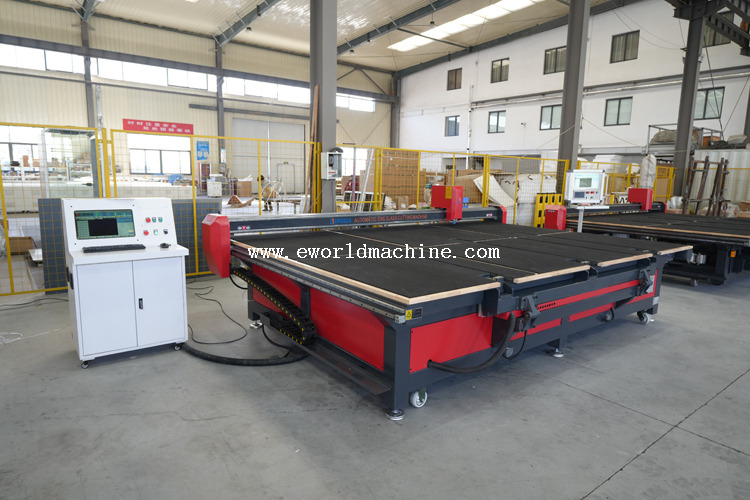
CNC glass cutting machines use automated motion control, cutting path software, and adjustable scoring pressure to process different glass sizes and shapes. They support complex cutting patterns, improve accuracy, and reduce manual intervention. Explore Eworld's automatic glass cutting machines for suitable production configurations.
Semi-automatic glass cutting machines combine motorized scoring with manual glass positioning, parameter adjustments, and breakout operations. They are generally suitable for smaller workshops processing standard rectangular glass sheets. Compared with CNC systems, they offer lower initial investment but require greater operator involvement and provide less flexibility for complex shapes.
CNC glass cutting machines provide automated positioning and consistent cutting pressure, helping achieve higher precision than semi-automatic systems. Depending on machine specifications, CNC equipment may support tolerances around ±0.15 mm, while semi-automatic cutting can have greater variation. Accurate scoring reduces edge chipping, material waste, and downstream processing defects.
CNC glass cutting machines improve production efficiency through automated cutting paths, optimized head movement, and consistent operating speeds. Semi-automatic machines depend more on operator handling and manual adjustments, which can increase cycle-time variation. CNC automation is particularly beneficial for high-volume glass processing and predictable production schedules.
Glass cutting optimization software uses automated nesting to arrange different shapes and dimensions efficiently on glass sheets. CNC systems can optimize cutting paths and material utilization, reducing offcuts and waste. Compared with manual layout planning, automatic optimization is particularly valuable for mixed-size orders and large-scale production.
CNC glass cutting machine maintenance includes sensor cleaning, servo system inspections, software checks, and regular calibration. Semi-automatic machines generally require simpler maintenance, such as guide rail lubrication, pneumatic system inspection, and cutting wheel replacement. Both machine types benefit from preventive maintenance to maintain cutting accuracy and minimize downtime.
Maintenance Item | CNC Glass Cutting Machine | Semi-Automatic Machine |
|---|---|---|
Daily | Clean sensors, check cutting oil and air pressure | Clean cutting table and inspect mechanical stops |
Weekly | Inspect drive components and vacuum systems | Lubricate rails and check pneumatic hoses |
Monthly | Check axis alignment and electrical connections | Inspect belts and cutting wheels |
Periodic Service | System diagnostics and calibration | Mechanical adjustments and component replacement |
CNC glass cutting machines require higher initial investment but can reduce long-term costs through labor savings, improved material utilization, and increased production capacity. Semi-automatic equipment offers lower upfront costs for smaller operations. Buyers should compare equipment pricing, expected output, scrap reduction, and maintenance expenses when calculating ROI.
CNC glass cutting equipment typically consumes more electricity due to servo motors, vacuum systems, and automated controls. Semi-automatic machines generally have lower power requirements. However, CNC systems may achieve better energy efficiency per square meter of processed glass during high-volume production. Actual consumption depends on machine configuration and operating conditions.
CNC glass cutting automation reduces manual handling but requires operators familiar with cutting software, machine settings, and troubleshooting. Semi-automatic machines usually involve simpler controls but greater labor input. Manufacturers should evaluate operator training, staffing requirements, production volume, and labor costs when choosing equipment.
CNC glass cutting machine integration requires compatibility with existing production software and digital cutting files. Buyers should verify supported formats, such as DXF, and available ERP or MES connectivity where required. Testing software compatibility before installation helps prevent data transfer errors and production interruptions.
CNC glass cutting machine training should cover software operation, cutting path optimization, machine calibration, and safety procedures. Manufacturer-supported training and gradual equipment implementation help operators adapt to automated workflows. Maintaining existing equipment during the transition can reduce production disruptions.
CNC glass cutting machine installation requires sufficient floor space, stable electrical power, and an appropriate compressed air supply. Some systems also require vacuum equipment and additional loading space. Manufacturers should verify machine-specific utility requirements and factory layout before purchasing to avoid installation delays.
Infrastructure Requirement | CNC Specifications | Semi-Automatic Specifications |
|---|---|---|
Electrical Supply | 3-Phase, 400V/480V, stable voltage required. | Single or 3-Phase, lower voltage tolerance. |
Compressed Air | 6-8 bar, strictly dry and oil-free. | 4-6 bar, standard shop air acceptable. |
Floor Space | Large footprint for loading, cutting, and breakout tables. | Compact footprint, often a single standalone table. |
Network Connectivity | Hardwired Ethernet for ERP and MES integration. | None required. |
There is no universally superior machine for every factory. The right choice is dictated entirely by your specific product mix, volume demands, and capital constraints. Opt for a CNC system if your facility processes high volumes, custom shapes, varying glass thicknesses, or requires strict integration with factory management software. Opt for a semi-automatic machine if your production consists of standardized, straight-line cuts where rapid deployment and lower upfront costs are the immediate priority.
Take the following actionable steps before making a final procurement decision:
Request a time-study and yield-optimization simulation from equipment manufacturers using your actual historical production data.
Conduct a comprehensive facility audit to verify that your electrical and compressed air systems meet the specifications of automated equipment.
Evaluate your current scrap rates to determine the exact financial value of a 5% to 10% yield improvement.
Require a software integration proof-of-concept from the vendor to ensure compatibility with your existing ERP system.
A: With strict adherence to preventative maintenance schedules, an industrial machine typically lasts between 10 and 15 years. CNC models require computer and software upgrades during this lifecycle to remain compatible with modern factory networks. Mechanical components like guide rails, rack and pinion gears, and servo motors need periodic replacement based on shift usage and cutting volume.
A: No. Semi-automatic machines are engineered specifically for straight-line cuts. The motorized bridge moves along a single axis while the operator sets the opposing dimension. Processing complex curves, circles, or custom geometric shapes requires the multi-axis interpolation capabilities of a fully automated CNC system.
A: Automatic nesting software typically improves material yield by 5% to 15%, depending on the baseline efficiency of your manual processes. The software uses algorithms to interlock shapes, share cut lines, and utilize the maximum surface area of a jumbo sheet. This drastically reduces skeleton waste and maximizes usable material.
A: CNC systems generally require a stable 3-phase electrical supply, often 400V or 480V depending on your region. They also require a dedicated source of clean, dry, and oil-free compressed air, typically delivered at 6 to 8 bar. Moisture or oil in the air lines will severely damage the sensitive proportional valves.
A: CNC machines utilize electronic proportional valves to adjust pneumatic pressure dynamically. The software reads the material profile from the cut list and automatically increases or decreases the downward force on the scoring wheel. This ensures optimal penetration without crushing delicate coatings or failing to score thick laminated sheets.
A: Basic operational proficiency takes approximately one to two weeks of dedicated on-site training. Mastering advanced troubleshooting, custom shape programming, and yield optimization software can take several months. Vendors typically provide initial installation training followed by advanced modules once the operator is comfortable with daily production runs.
 简体中文
简体中文