


Views: 0 Author: Site Editor Publish Time: 2026-04-14 Origin: Site


When people ask what machines are used in glass manufacturing, they are often thinking of one impressive machine doing all the work. In reality, modern glass production is a chain of tightly connected processes, and each stage depends on a different kind of Glass Machinery. Raw materials must be stored, weighed, and mixed correctly. Glass must be melted, formed, cooled, cut, cleaned, shaped, strengthened, or assembled into higher-value products. That means a real answer has to cover both primary flat-glass production and downstream glass processing. The machine list can include batch house systems, melting furnaces, float baths, annealing lehrs, cutting tables, edging machines, washing lines, tempering furnaces, laminating equipment, insulating glass lines, and several specialized machines for drilling, printing, sandblasting, lifting, and bending. Understanding how these machines fit together is useful not only for engineers and factory managers, but also for buyers who want to plan a workshop more intelligently and avoid investing in equipment that does not match their product mix.
The first thing to understand is that “glass manufacturing” can refer to two very different production environments. One is flat glass production, where raw materials are turned into float glass sheets through melting, forming, and controlled cooling. The other is glass processing, where those sheets are transformed into finished products such as tempered glass, laminated glass, insulated glass, furniture glass, door glass, or decorative architectural glass. The machinery needed for these two workflows is not the same. A float plant depends on large continuous equipment, while a processor usually builds a flexible workshop around cutting, edging, washing, tempering, laminating, or insulating systems.
Every float line starts before the furnace. Silica sand, soda ash, limestone, dolomite, and cullet need to be stored, measured, mixed, and transferred in the correct ratio. This is where batch house equipment comes in. Silos, feeders, conveyors, weighing systems, and mixers are all part of the first layer of Glass Machinery. They may not look as dramatic as the furnace, but they are essential because poor batch consistency can create quality problems all the way downstream. Vitro’s explanation of the float process notes that raw materials are weighed, mixed, and moved by conveyor from the batch house into the furnace, which shows how fundamental this equipment is to stable glass production.
Once the batch is prepared, it enters the melting furnace, the core machine in primary glass production. The furnace converts the raw mixture into molten glass at sustained high temperatures. In practical terms, this machine determines much of the plant’s output stability, energy use, and melt quality. Guardian Glass describes float glass as being made by dissolving raw materials in a furnace before the glass is poured onto molten tin, while Pilkington similarly identifies the furnace as the stage that feeds the float bath. Without a stable furnace, there is no consistent ribbon of glass to shape later.
After melting, the molten glass flows onto a bath of molten tin. This is the defining feature of the float process. As the glass floats on the tin, gravity and surface tension help form a flat, smooth ribbon. Pilkington states that molten glass is poured continuously onto a shallow bath of molten tin, where it spreads out and forms a level surface. This stage is where flatness, thickness behavior, and ribbon stability are established, making float-bath-related equipment one of the most important categories in the entire glass industry.
After forming, the ribbon cannot simply cool naturally. It must pass through an annealing lehr, where cooling is controlled to reduce internal stresses. Grenzebach describes the annealing lehr as a key factor in glass manufacturing because it is where glass tension and quality are determined. Guardian also notes that once the glass exits the tin bath, it is progressively cooled in the annealing lehr so that stress can be released from the ribbon. This stage matters because poor stress control can lead to breakage or quality problems during later cutting and processing.
Production Stage |
Main Machine Type |
Main Purpose |
Raw material preparation |
Batch house equipment |
Weighing, mixing, and conveying raw materials |
Melting |
Glass furnace |
Converts batch into molten glass |
Forming |
Float bath system |
Creates flat glass ribbon |
Controlled cooling |
Annealing lehr |
Relieves stress and stabilizes quality |
Sizing |
Glass cutting machine |
Cuts glass to required dimensions |
Edge finishing |
Glass edging machine |
Smooths and polishes edges |
Cleaning |
Glass washing machine |
Removes dust, oil, slurry, and residues |
Strengthening |
Tempering furnace |
Produces safety glass through heat treatment |
Bonding |
Laminating machine |
Combines glass with interlayers |
Assembly |
Insulating glass line |
Produces double or multiple glazed units |
This table shows why the term Glass Machinery covers much more than one or two machines. It spans the entire journey from raw mineral ingredients to finished architectural or decorative products.
Once float glass has been made, the next stage is processing. This is the part of the industry where many buyers, fabricators, and workshop owners spend most of their time.
Cutting is usually the first operation in a glass processing workshop. A glass cutting machine sizes sheets according to the product drawing and sets the dimensional foundation for every later step. Eworld’s current product range includes automatic glass cutting machines, integrated glass cutting lines, loading and breaking tables, semi-automatic cutting machines, and laminated glass cutting machines. The company’s own 2025 industry article also notes that cutting machines are indispensable in preliminary glass processing and provide the foundation for later steps such as edge grinding and tempering.
After cutting, glass often needs edge finishing. Edging machines grind and polish the cut edges so the glass becomes smoother, safer to handle, and better prepared for later use. Eworld’s official edging category includes straight-line edging and polishing machines, shape edging machines, chamfer edging equipment, and small edge-processing machines. Its industry explanation of edge grinding says the purpose is to make glass edges smooth, flat, and visually better while improving safety and performance. For many factories, edging is not just cosmetic; it also reduces handling risk and supports higher-quality finished products.
Before tempering, laminating, coating, or insulating assembly, the glass surface must be clean. Washing machines remove dust, fingerprints, grease, slurry, and residues. Eworld’s glass washing article explicitly states that these machines clean, rinse, and dry glass and that residue left on the glass can ruin coatings or tempering processes. That makes washing one of the most underestimated but most critical steps in modern glass processing. A workshop with strong cutting and edging capacity can still lose quality if the cleaning step is weak.
For shower doors, hardware-mounted panels, railings, appliance glass, and many custom products, drilling is also essential. Eworld’s published product categories include Glass Drilling Machine, which reflects the importance of preparing holes and fittings accurately before installation or further treatment. Drilling machines are especially important in value-added fabrication because dimensional precision affects both appearance and assembly reliability.
Not every piece of glass leaves the factory as ordinary annealed sheet. Many end markets demand stronger, safer, or more energy-efficient products. That is where another layer of Glass Machinery becomes necessary.
Tempering Furnaces
A tempering furnace heats glass and then cools it rapidly to increase strength and improve breakage behavior. Eworld’s product catalog includes tempered glass machines and tempered bending machines, while its industry pages also show ongoing technical discussion around tempering furnace maintenance. In practical production terms, tempering is one of the key upgrades that turns cut and cleaned glass into safety glass for doors, partitions, façades, and many other applications.
Laminating Equipment
Laminated glass is made by bonding glass layers together with interlayers such as EVA or PVB. Eworld’s laminating product category includes EVA film laminating machines, PVB automatic laminating machines, PVB laminated glass production lines, and curing autoclave-related machinery. This type of equipment is widely used when manufacturers want added safety, decorative layers, or specialized functional performance. Laminating machinery is especially relevant for architectural safety glass and premium interior products.
Insulating Glass Lines
For windows, façades, and energy-saving building products, insulating glass lines are essential. Eworld’s official product range includes insulating glass production lines, sealing extruders, accessory machines, argon gas filling machines, aluminum spacer bending machines, and horizontal or vertical double-glazing systems. This shows that insulating glass production is not one machine alone but a coordinated system for washing, spacer preparation, assembly, sealing, and optional gas filling.
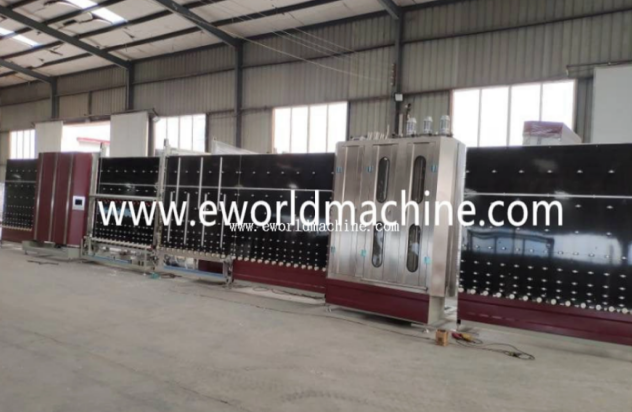
Once a workshop moves beyond standard flat panels, specialized equipment becomes increasingly important. Eworld’s current categories also include Glass Screen Printing Machine, Glass Sandblasting Machine, Glass Lifting Equipment, and Tempered Bending Machine. These machines support decorative, shaped, handled, or project-specific products. Sandblasting equipment, for example, is used to create frosted or patterned surfaces, while tempered bending machines combine heat and forming for shaped glass used in architecture, furniture, or automotive-related applications. Lifting equipment, although sometimes overlooked, is also an important part of safe production flow when large sheets need to be moved efficiently across stations.
This is where many equipment decisions go wrong. A factory making simple window panes does not need the same setup as a processor focused on shower enclosures, laminated balustrades, or insulated curtain-wall units. The right Glass Machinery package depends on product type, target volume, labor skill level, required accuracy, and available floor space.
· If the focus is standard sheet sizing and resale, cutting and loading systems may be the first priority.
· If the business concentrates on furniture glass or frameless doors, edging, drilling, and washing become far more important.
· If the goal is safety glass, then tempering or laminating equipment becomes central to the line.
· If the market is energy-efficient construction, insulating glass systems and sealing-related machines should move higher on the investment list.
A common mistake is choosing equipment because it looks advanced rather than because it matches the intended product. A cutting line may be highly automated, but if the factory’s real bottleneck is poor edge quality or cleaning consistency, the better investment could be edging or washing equipment. Eworld’s own published product structure is a useful reminder that glass processing is normally built from several connected machine categories rather than one stand-alone “hero” machine.
Good factories do not evaluate machines in isolation. They ask whether the output of one station supports the next. Cutting affects edging. Edging affects washing. Washing affects tempering and laminating. Sealing quality matters in insulating glass. The stronger the process chain, the lower the rework rate and the more predictable the final quality. This is exactly why complete equipment planning often delivers better results than purchasing scattered machines from unrelated workflows.
Higher automation is not automatically better for every buyer. Some workshops need a compact, flexible line; others need throughput and labor savings. Eworld publicly presents both stand-alone machines and larger production-line solutions, including integrated cutting lines and complete insulating glass systems, which suggests that machine selection should be matched to actual output targets rather than trends alone.
So, what machines are used in glass manufacturing? The honest answer is that there is no single-machine answer. Modern Glass Machinery includes the equipment that prepares raw materials, melts glass, forms the ribbon, cools it under control, cuts it, finishes the edges, cleans it, strengthens it, laminates it, seals it into insulating units, and adds specialized functions such as drilling, printing, sandblasting, lifting, or bending. That is why buyers should think in terms of a production route rather than a shopping list. From our perspective, the best equipment plan is the one that matches the factory’s real product direction and creates a smooth connection between each step. At Shandong Eworld Machine Co.,Ltd, we see that many customers today are not simply looking for one cutting machine or one washer; they want a practical combination of machines that can support a complete and efficient processing workflow. If you are comparing equipment for a new workshop, an expansion project, or a line upgrade, it is worth learning more about this company’s current glass equipment range and discussing which machine combination fits your production goals most naturally.
That depends on the product, but for many workshops the cutting machine is the starting point because it establishes the size and geometry for all later steps. Still, cutting alone is rarely enough for a complete processing business.
Because contamination on the surface can affect later quality. Eworld’s washing-machine explanation specifically mentions that dust, fingerprints, grease, and residues can interfere with coatings or tempering-related results.
Insulating glass production typically involves washing equipment, spacer-related machines, assembly systems, sealing equipment, and often gas-filling devices. Eworld’s published insulating-glass range reflects exactly that kind of multi-machine workflow.
Not exactly. Tempering mainly strengthens glass through heat treatment, while laminating bonds layers together with interlayers for safety and additional performance. Many factories use both, but they solve different production needs.


