


Sheet yield on a CNC glass cutting line is the area of usable cut parts divided by the area of sheet you consumed, and most of that number is settled before the cutting head moves: by the stock sheet sizes you buy, the nesting layout the optimisation software produces, the allowances your own process requires, and the way orders are grouped onto sheets. Improving it is a specification and measurement task rather than a software upgrade. Define the metric, obtain the allowance data that applies to your glass, compare quotations on identical fields, and prove any gain on your own order set.
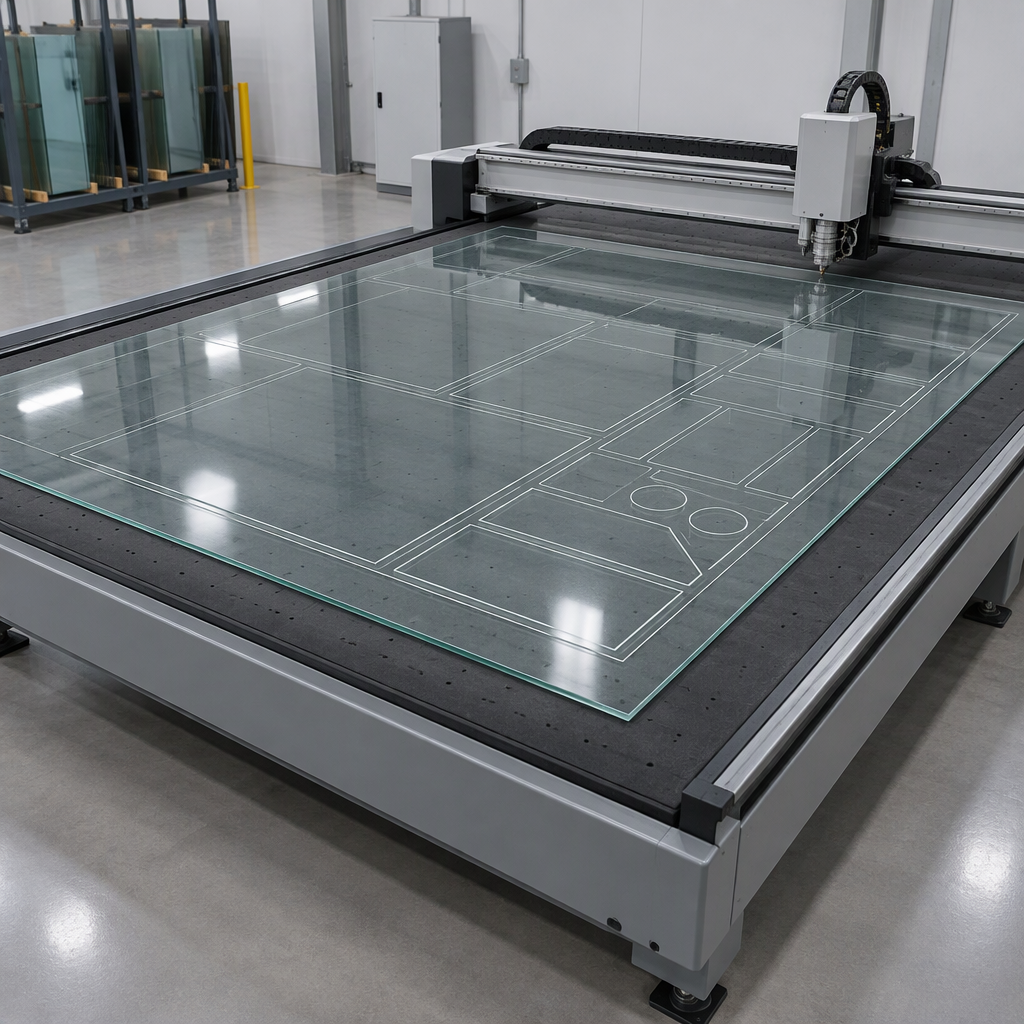
Which Levers Raise Sheet Yield Before the Cutting Head Moves
Four levers decide most of your yield before any cut is made: the stock sheet sizes you buy, the nesting layout the optimisation software produces, the allowances that layout must respect, and how orders are grouped onto sheets.
Published CNC glass cutting systems pair a Windows-based industrial computer with professional cutting optimisation software and CAD-compatible graphic input, so a layout can be generated, edited and re-run for each order instead of being marked out by hand.
- Sheet size: a stock size that divides well into your part mix sets the ceiling on any nesting result.
- Software: layout optimisation rearranges the parts it is given; it cannot create area or overrule an allowance.
- Allowances: edge trim, cutting-wheel spacing and clamping margins define the usable rectangle.
- Order grouping: batching by glass type, thickness and colour keeps remanent offcuts usable rather than dead stock.
Sheet size and order grouping often matter more than software settings, because a nesting pattern can only rearrange the parts it receives.
Why a Nesting Layout Cannot Use Every Square Millimetre
A nesting layout can only place parts inside a usable rectangle. The rest of the sheet goes to edge trim, spacing for the cutting wheel and breakout, clamping and handling margins, and remanent offcuts too small to re-use. Take the real allowance values from your own glass, edge-working process and machine.
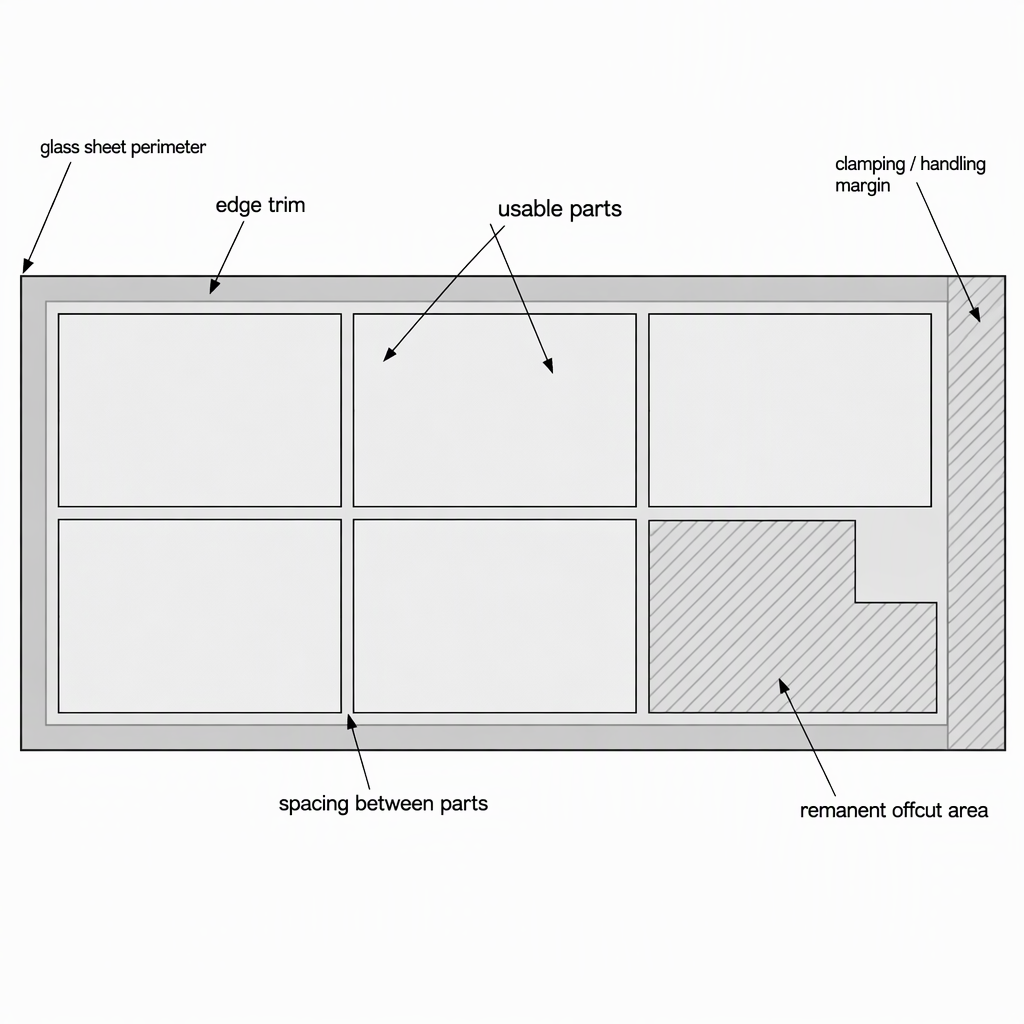
Trim and spacing usually dominate the difference between the sheet area you buy and the area a layout can occupy: the cutting wheel needs a clean run between adjacent cuts, breakout needs room or suction support, and clamping or loading devices need their own margin.
- Edge trim required per side by your cutting process and by the condition of the sheets you receive.
- Minimum spacing between adjacent cuts for scribing, breakout and any bridge or head travel.
- Clamping, suction-cup, conveyor or loading margins at the sheet edges.
- Minimum part size and minimum offcut size that your line, your racking and your order book can genuinely handle.
- Shape allowance for non-rectangular parts, including any grinding or edge-polishing removal.
- Breakage and rework allowance per order family, taken from your own records rather than assumed.
Which Published Specifications Belong in a Cutting-Machine Comparison
Ask for the same field set in every quotation so two options can be compared on yield rather than on headline price: sheet and table envelope, thickness and glass-type range, published cutting and parallel tolerances, the optimisation software and its import and export formats, and the conformity documents that must travel with the machine.
| Quotation field | Why it changes yield | What to require in writing |
|---|---|---|
| Maximum sheet and table envelope | Sets the largest stock size you can buy, store and nest into | Exact maximum sheet size and table footprint |
| Thickness and glass-type range | Laminated, coated and thick glass need different allowance values | Range stated per glass type, including laminated build-ups |
| Published cutting and parallel tolerance | Decides whether a nested part is saleable first time or becomes rework | Tolerance figures together with the sheet size and measuring method they apply to |
| Optimisation software scope | Determines whether layouts adapt per order and which part files can be imported | Software name and licence terms, supported import and export formats, operator training |
| Interfaces to loading, washing, insulating-glass and tempering steps | Decides whether the cutting pattern survives the rest of the line without manual re-work | Machine-to-machine interfaces and file formats at each step, plus who commissions them |
| Conformity documentation | Determines whether the machine can be commissioned and used legally | Applicable legislation, declaration of conformity and availability of the technical file |
The full-automatic CNC cutting line published by Shandong Eworld Machine Co., Ltd. shows the level of detail worth requesting: cutting accuracy of ≤ ±0.20 mm, parallel accuracy of ≤ ±0.15 mm/m, cutting speed of 0-120 m/min and a maximum glass size of 4200 × 2800 mm, with the layout optimisation software running on an industrial computer. Ask every supplier for the same categories at the same level of specificity.
How to Prove a Yield Gain on Your Own Order Set
Freeze a representative order set, record the sheet area consumed and the saleable part area produced for each order before and after the change, and compare like with like.
- Choose the test set: orders that span your typical part sizes, glass types, thicknesses and batch sizes, and write down the mix.
- Record the baseline: sheet area consumed, good part area produced, and breakage or rework per order.
- Keep the layout file for each order, so any difference can be traced to a layout change rather than to a measurement change.
- Hold the stock sheet sizes constant. Changing sheet size moves the result without the machine changing, and it hides what you are trying to measure.
- Compare family by family, and report yield per glass type and per part-size band instead of one blended figure.
- Investigate any fall in yield at the cutting, breakout and edge-working steps before you attribute it to the nesting layout.
- The same part list and quantities are used in both runs.
- Glass type, thickness and stock sheet size are identical in both runs.
- Breakage, chipping and rework are counted in both runs, not only good output.
- Offcuts are counted as recovered only where they were genuinely cut again.
- The sample contains enough orders that one unusual job cannot swing the result.
- One written definition of yield is used by everyone on the project.
What Cutting Optimization Cannot Fix
Optimisation cannot create glass area, cannot remove breakage or rework losses, and cannot overrule an allowance that your process or your glass type requires. It also cannot rescue a part mix that does not fit the stock sheets you buy, or an offcut store that nobody picks from.
Coated, textured, patterned and heat-treated glass deserve their own allowance checks with the process that supplies them, and a change of glass supplier can shift edge quality and therefore trim.
Safety and Conformity Boundaries to Confirm Before Signing
The supplier's obligation is documentation: a cutting machine placed on the EU market must meet the essential health and safety requirements of the applicable machinery legislation and be supplied with the correct conformity documents. Guarding, housekeeping around the cutting table, glass handling and operator training for your installation remain your responsibility under your local rules and your safety file.
Before any manual work inside the machine, including cleaning the cutting bridge and table, removing a trapped offcut or inspecting the cutting wheel, switch the machine off and disconnect it from its power supply, and then use only the access steps the machine manual permits. Never defeat, remove or bypass a guard or interlock to reach a part, and follow the handling method and protective equipment your own risk assessment sets for moving sheets.
- The legislation that applies in your destination country, and the date from which it applies.
- A declaration of conformity and CE marking where the EU machinery rules apply, with the technical file available on request.
- The harmonised standards the machine was assessed against, and the machine risk assessment.
- Operating and maintenance manuals, a maintenance schedule and spare-parts lists in a language your operators read.
- Operator and maintenance training that matches the guarding and access design you actually ordered.
- Written confirmation that the loading, cutting and breakout arrangements suit the way your team will work.
How to Choose a Cutting Configuration for Your Order Mix
Match the configuration to your order mix rather than to the largest sheet you can imagine buying. Large float sheets cut into standard units suit a full-automatic line with automatic loading and layout optimisation; small mixed batches with frequent changeovers may suit a PLC semi-automatic table; laminated work needs a machine specified for laminated build-ups.
The supplier behind this site publishes under the English trading name Shandong Eworld Machine Co., Ltd. and describes itself as a manufacturer of glass processing, window and door and CNC equipment established in 2014.
Its published glass cutting range covers a full-automatic CNC cutting line, an integrated cutting line with automatic loading, an automatic laminated glass cutting machine, a PLC semi-automatic cutting table and manual or semi-automatic machines, with a maximum glass size stated up to 4200 × 2800 mm on the CNC line.
- What share of your work is one glass type and thickness, and how often do you change over?
- What is the largest stock sheet you can actually buy, store, move and feed into the machine in your building?
- Must the cut glass feed a washing machine, an insulating-glass line or a tempering line, and does the cutting file need to travel with the batch?
- How much of your work is laminated, coated or thick glass, and what tolerances do those processes need?
- How many shifts will run the machine, and who will carry out maintenance and software updates?
- Where will remanent offcuts be stored, labelled, measured and retrieved for the next order?
Answer those questions before you compare prices. The configuration that fits your order mix will use your stock sheet sizes better than a larger or faster machine that forces you to buy sheets your orders cannot absorb.
The Practical Order of Work
Fix the metric first, collect the allowance and order data that only your own plant can supply, then compare quotations on identical fields and prove the result on a frozen order set before you commit to a configuration.
- Define sheet yield in writing and agree who records it and how often.
- Collect your own inputs: stock sheet sizes, part mix, glass types, trim and spacing values, breakage and rework rates.
- Request quotations on the same field set, together with the conformity documents for your destination country.
- Run the frozen-order-set comparison and repeat it after installation.
- Confirm guarding, access, handling and training for your installation before commissioning, and record them in your safety file.
Frequently Asked Questions
The answers below tell you what to check against your own order data and documentation.
How do I calculate sheet yield for a glass cutting order?
Divide the area of good parts by the area of sheet consumed for that order, and multiply by 100. Count only parts that pass inspection as good output, record breakage and rework separately, and credit an offcut as recovered only when it is genuinely cut again. Using one written definition across all orders is what makes the numbers comparable over time.
Can optimization software alone improve yield?
It can change the layout, and a better layout occupies more of the usable rectangle, so it can move the number. It cannot widen the usable rectangle that edge trim, spacing and clamping margins define, and it cannot use a stock size you do not buy. Treat software as one of four levers and measure the result on your own order set.
Does a bigger cutting table improve yield?
Not by itself. A larger table lets you handle larger stock sheets, which usually nest better, but it also brings more capital, floor space, handling equipment and offcut area, and the published maximum sheet size on a full-automatic CNC line is the figure that limits the stock you can buy. Compare measured yield on your typical orders against the total cost of the larger configuration.
Can CNC optimization improve laminated glass cutting?
The layout logic applies, but laminated glass is cut and broken out under wider published tolerances, up to ±0.5 mm parallel and ±1 mm diagonal across a 3+0.38+3 mm to 10+0.76+10 mm build-up range, so part sizes and the spacing around them must suit the laminated process rather than the tightest float figure. Confirm the tolerance values for the machine and the build-ups you actually buy.
Does tighter cutting accuracy improve sheet yield?
Indirectly. Tolerance decides whether a nested part is usable without rework, and reworked or scrapped parts reduce the yield you book, but tolerance does not change how much sheet area a layout covers. Look for fewer re-cuts, fewer rejects and fewer breakouts on the same order set rather than reading a tolerance figure as a yield improvement.
What order data should I send a supplier for a cutting configuration proposal?
Send a part list with dimensions, quantities and shapes; the glass types, thicknesses and coatings you run; the stock sheet sizes you can buy and store; the edge work each part needs; your shift pattern and typical batch sizes; the destination country, so conformity documents match; and any fixed points such as the loader, washer or insulating-glass line the cut glass must feed.
What conformity documents should accompany an imported cutting machine?
Expect a declaration of conformity, CE marking where the EU machinery rules apply, the technical file available on request, and manuals with a machine risk assessment. Voluntary certificates are not a recognised substitute for those documents, and their value in market surveillance or customs checks should not be assumed. Confirm the rules that apply in your own country before you sign.
How long does a cutting upgrade take to pay back?
There is no reliable general figure, and a supplier percentage claim should not enter your model untested. Build the calculation from your own numbers: the measured change in yield on a frozen order set, your glass cost per square metre, and any change in consumables, breakage, labour, electricity and downtime.


