


Start with the production problem, not the machine label
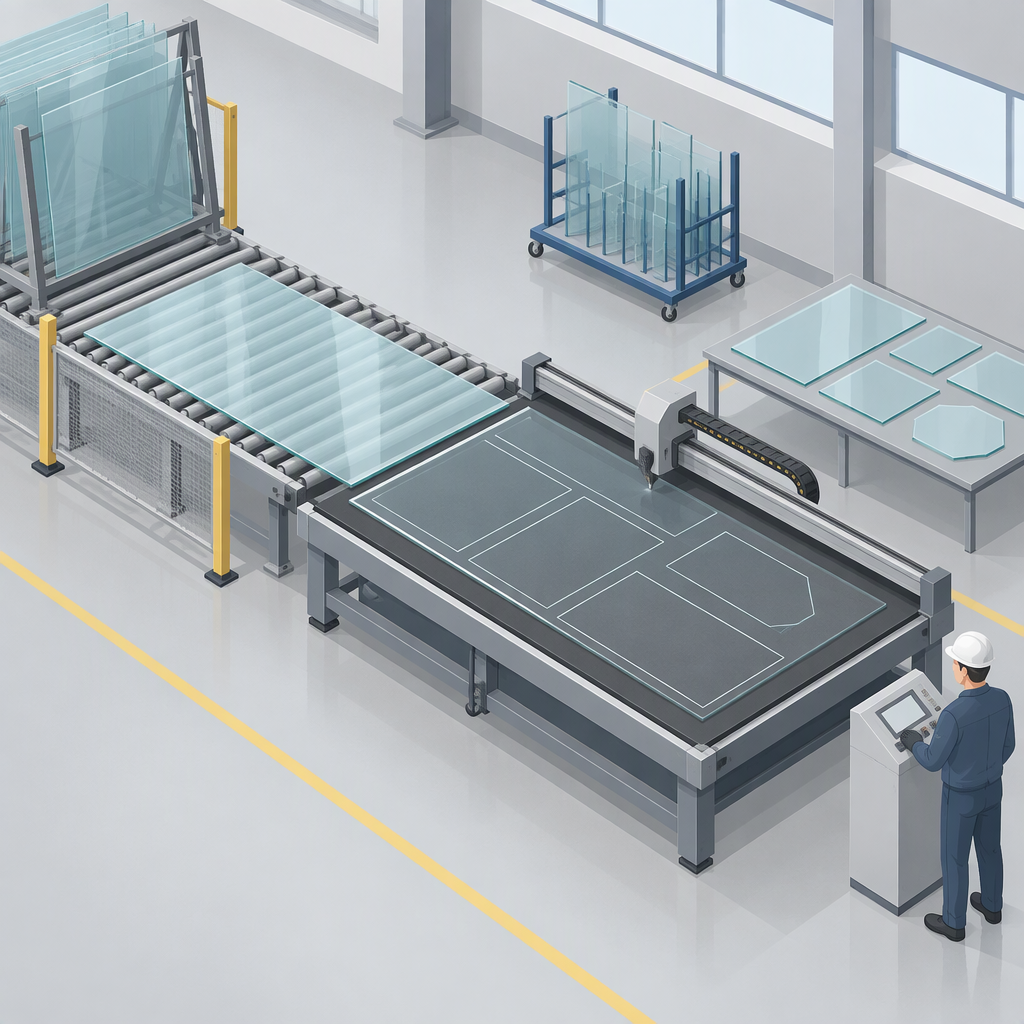
Flat glass processing turns raw panes into finished items such as window glass, shopfront elements, stairs and tables, and cutting is a universal process in that workflow. Start selection by describing the panes, patterns and output you need before comparing machine labels.
| Selection question | Why it matters | What to confirm before shortlisting |
|---|---|---|
| What is the largest regular sheet? | The cutting stage works on raw glass panes before later processing. | Usable table area, loading clearance and realistic allowance around the pane. |
| Is the work mostly repeated or job-specific? | Flat glass production can be individual or batch-oriented, with single-glass-element data needed for different jobs. | How often patterns change and whether the cutting system must receive many individual job files. |
| Does the shop cut monolithic or laminated glass? | Mechanical cutting inscribes the surface and breaks along prescribed lines; laminated glass can require an added foil-separation step. | Glass build-up, interlayer type, thickness range and whether a laminated-glass cutting function is required. |
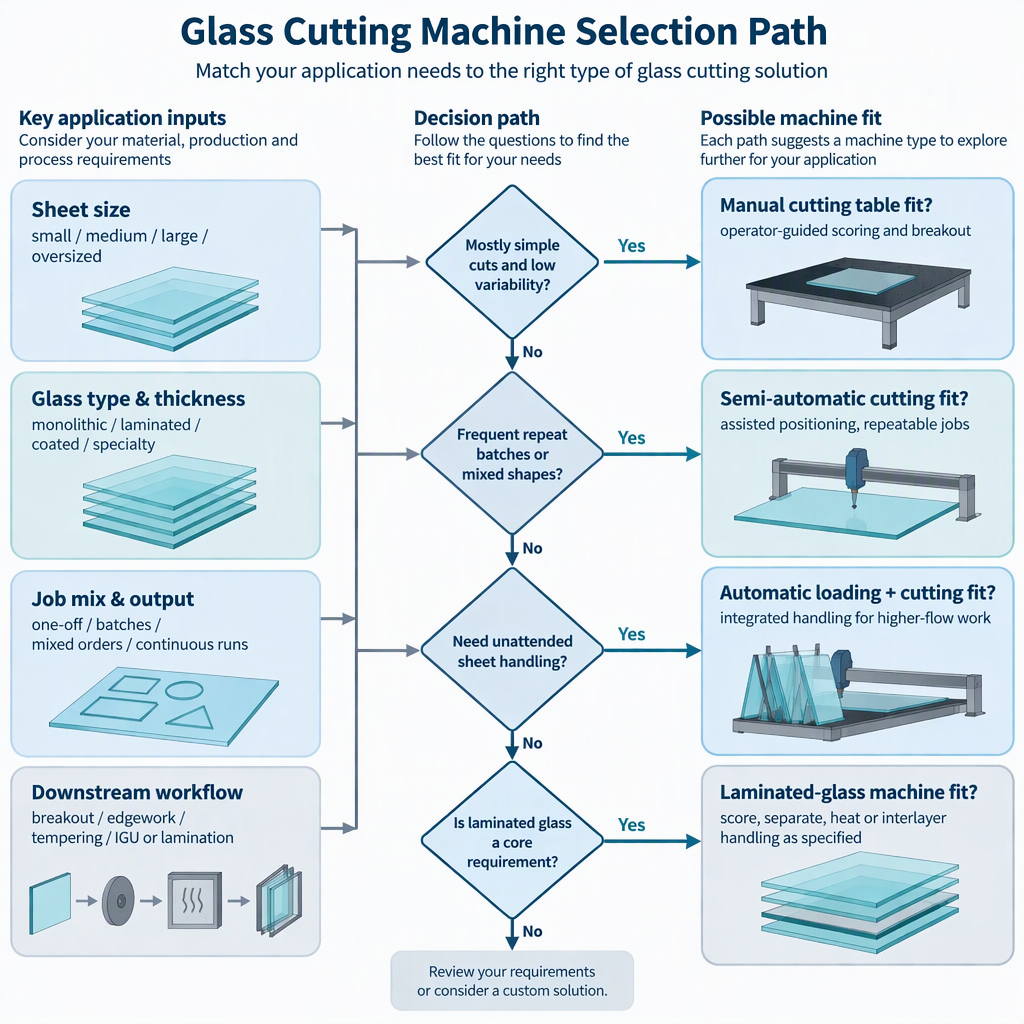
| How much handling can the line absorb? | The first-party product page presents manual, semi-automatic, PLC semi-automatic, automatic loading/cutting and full-automatic CNC cutting line categories. | Whether manual loading is acceptable or whether automatic loading and line integration are needed. |
For the underlying workflow, the OPC UA for Flat Glass Processing specification describes transport to the cutting table, pattern inscription and breaking along prescribed lines. Use that sequence as a neutral way to map your own process before judging supplier claims.
Match table size to the largest regular sheet
A first-party product page gives example maximum glass-size figures such as 4200 × 2800 mm in one page area and 3660 × 2440 mm in another. Use those figures only as a prompt to ask which exact model and configuration fit your largest recurring sheet.
- List the largest sheet you process weekly, not only the theoretical largest sheet you may buy once a year.
- Record the common sheet sizes for doors, windows, partitions or other products so the supplier can judge everyday table utilization.
- Ask whether the stated maximum size refers to loading, positioning, cutting, breaking, or the whole line.
- Check whether the shop floor can support loading space, operator movement, glass storage, offcut removal and safe access around the table.
- If you are comparing manual, semi-automatic and automatic loading/cutting categories, ask how sheet loading changes the real cycle for large panes.
Do not assume every listed figure applies to every model on a category page. Maximum processing size, cutting speed and thickness examples should be tied to the exact quotation, layout drawing and selected options.
Confirm glass type and thickness before choosing the cutting method
The cutting method must match the material: ordinary mechanical flat glass cutting inscribes and breaks the pane, while laminated-glass cutting may require separating the foil between panes. Thickness and build-up therefore belong in the first RFQ message, not at the final negotiation stage.
| Material question | Selection impact | Buyer action |
|---|---|---|
| Monolithic flat glass | The basic process is surface inscription followed by breaking along prescribed lines. | Confirm the thickness range, cutting wheel or tool arrangement, breaking method and edge quality expectations. |
| Laminated glass | Laminated-glass cutting can add foil separation between panes. | Ask whether the proposed machine is designed for laminated glass and request the supported build-ups in writing. |
| Mixed daily production | When panes and patterns vary, machinery may need job-level information for each glass element. | Describe how often thickness, shape and cutting pattern change during one shift. |
| Supplier page examples | The first-party page includes laminated-glass thickness examples from 3+0.38+3 mm to 10+0.76+10 mm. | Ask the supplier to confirm whether your exact laminated specification is inside the quoted machine’s capability. |
Do not convert a general category figure into a process guarantee. For special glass, coated glass, very small parts or unusual shapes, send drawings and material details so the supplier can confirm the method, limits and trial requirements.
Translate output into jobs, handling steps and automation
Output depends on job mix as well as speed because 100 raw panes can require 100 jobs when each pane has an individual pattern. A useful automation decision converts daily demand into jobs, loading moves, cutting files, breaking steps and downstream handoffs.
| Production condition | Likely selection pressure | Question to ask suppliers |
|---|---|---|
| Low volume, stable sizes | Manual or semi-automatic machine categories may be part of the shortlist. | What manual loading, positioning and breaking steps are required for the daily sheet count? |
| Frequent large sheets | Automatic loading/cutting line categories may reduce repeated handling steps. | How does the proposed line load, position, cut and transfer the largest regular sheet? |
| High pattern variety | Individual or batch-oriented production can require single-glass-element information. | How are cutting patterns imported, scheduled and changed between jobs? |
| Laminated-glass output | The first-party page lists an automatic laminated glass cutting machine category. | Which laminated build-ups and foil-separation steps are included in the quoted configuration? |
| Speed-driven shortlist | The first-party page states cutting-speed examples up to 150 m/min. | What output is expected for your actual sheet sizes, shapes, loading method and job mix? |
- Calculate your average and peak sheets per shift by size family.
- Group the work by repeated patterns versus individual job files, because job-level variation can change the production burden.
- Map each handling step: storage, loading, positioning, cutting, breaking, offcut removal and transfer to the next process.
- Ask the supplier to model output using your sheet list and drawing mix rather than only the highest listed cutting speed.
Check edge, cleaning and laminated-glass workflow fit
Cutting is one process inside broader flat glass processing, which can lead to products for windows, shopfronts, stairs, tables and other applications. The right shortlist should fit the next process after cutting, not just make a cut on the table.
- State whether parts go next to edging, drilling, tempering, insulating glass production, lamination, assembly or packing.
- For laminated glass, ask how the process handles scoring, breaking and foil separation before the next station.
- Define acceptable edge condition after cutting and before any downstream edge processing.
- Confirm how labels, job IDs or part tracking move from cutting to the next process when job variety is high.
- Ask what cleaning, scrap removal and table-care tasks are required between material changes.
- If a model requires manual clearing, cleaning or inspection inside guarded or powered areas, require a written procedure that switches off and disconnects the relevant power source before manual access, and follow only the access points permitted by the model manual.
What data to prepare before requesting a quotation
Send suppliers a compact production brief: sheet sizes, glass types, thickness ranges, laminated build-ups, output target, drawing mix, loading preference, factory layout and downstream process. That makes the quotation about your work instead of a generic model name.
- Largest, smallest and most common sheet sizes, with the largest regular sheet separated from rare oversize work.
- Glass type list: monolithic, laminated, coated or other materials that affect cutting and handling.
- Exact laminated-glass build-ups when relevant, because page examples such as 3+0.38+3 mm to 10+0.76+10 mm still need model-level confirmation.
- Daily and peak output targets, expressed as sheets, jobs and square meters if your team uses all three.
- Typical pattern variability, because individual panes may require individual job information.
- Preferred automation level, using categories such as manual, semi-automatic, PLC semi-automatic, automatic loading/cutting, full-automatic CNC line or laminated-glass cutting machine as starting points.
- Available floor space, loading direction, power and air utilities, operator staffing and downstream transfer requirements.
When a product page lists maximum glass size, cutting speed, accuracy or laminated-thickness examples, ask the supplier to restate the values on the quotation for the exact model, options and operating assumptions you plan to buy.
Selection limits and safety checks
A selection guide can narrow the shortlist, but the final purchase still needs local safety review, destination-market compliance checks, site layout approval and written operating procedures from the supplier.
Before purchase, ask for the machine manual, guarding description, emergency-stop arrangement, maintenance access rules, installation requirements and destination-market documents that apply to your country. If your team will clean, inspect or clear any powered equipment, the procedure should require switching off and disconnecting the relevant power source before manual access. Do not bypass guards or add informal disassembly steps outside the manual.
For procurement comparison, avoid claims that cannot be tied to the exact quoted configuration: certification, warranty terms, lead time, output rate, accuracy, staffing reduction and production improvement should all be confirmed in supplier documents before they influence the order.
Conclusion
The best glass cutting machine shortlist starts with your production facts, then uses supplier specifications to test fit.
- Start from the flat glass process and the products your factory makes.
- Separate ordinary flat glass cutting from laminated-glass requirements.
- Translate output into jobs and pattern changes, not only machine speed.
- Confirm every size, speed and thickness figure against the exact quoted model.
FAQs about glass cutting machine selection
Should I choose by the largest sheet my factory can ever receive?
Use the largest regular production sheet as the main sizing basis, then separately discuss rare oversize work. A machine bought only for rare exceptions may consume more floor space and budget than the daily mix requires.
Why should thickness be confirmed before the model shortlist?
Thickness and glass build-up affect the cutting method. Laminated glass can require foil separation in addition to surface inscription and breaking, so the supplier needs exact build-up details early.
Is cutting speed the same as factory output?
No. Output also depends on job changes, sheet loading, pattern variety, breaking, offcut removal and downstream transfer. Individual patterns can turn many panes into many separate jobs.
When does automatic loading become important?
Automatic loading/cutting line categories are most relevant when large sheets, repeated handling or higher daily volume make manual loading a bottleneck. The decision should be based on your sheet mix and factory layout.
Do I need a special machine for laminated glass?
Ask specifically about laminated-glass cutting because the workflow may include separating the foil between panes. Send the exact laminated build-up and expected output so the supplier can confirm suitability.
What should I send with an RFQ?
Send sheet sizes, thickness ranges, glass types, laminated build-ups, drawings or pattern examples, daily output targets, loading preference, floor layout and downstream process requirements. Ask the supplier to quote the exact configuration against those facts.
Can I rely on figures shown on a category page?
Use category-page figures as shortlist clues, not final purchase conditions. Request written confirmation of maximum size, thickness range, cutting speed and options for the exact model being quoted.


