WhatsApp: +8615665767071    Email: info@eworldmachine.com
You are here: Home / News / How to Specify a Double-Head Saw for Aluminum Window Profiles

How to Specify a Double-Head Saw for Aluminum Window Profiles

Views: 0     Author: Site Editor     Publish Time: 2026-11-16      Origin: Site

Inquire

facebook sharing button
twitter sharing button
line sharing button
wechat sharing button
linkedin sharing button
pinterest sharing button
whatsapp sharing button
sharethis sharing button

Specify a double-head saw for aluminum window profiles by defining the profile envelope, finished cut length, angle program, clamping needs, edge-quality expectations, utilities, guarding documents, and supplier evidence before asking for a price. Use EN 755-9 only as an incoming extruded-profile tolerance reference, because its stated scope is tolerances on dimensions and form for aluminium and aluminium alloy extruded profiles within a circumscribing circle not greater than 800 mm for general engineering applications. Treat first-party supplier pages as evidence of company identity and product-category coverage, not as proof of model-level specifications unless the specific specification page is supplied.

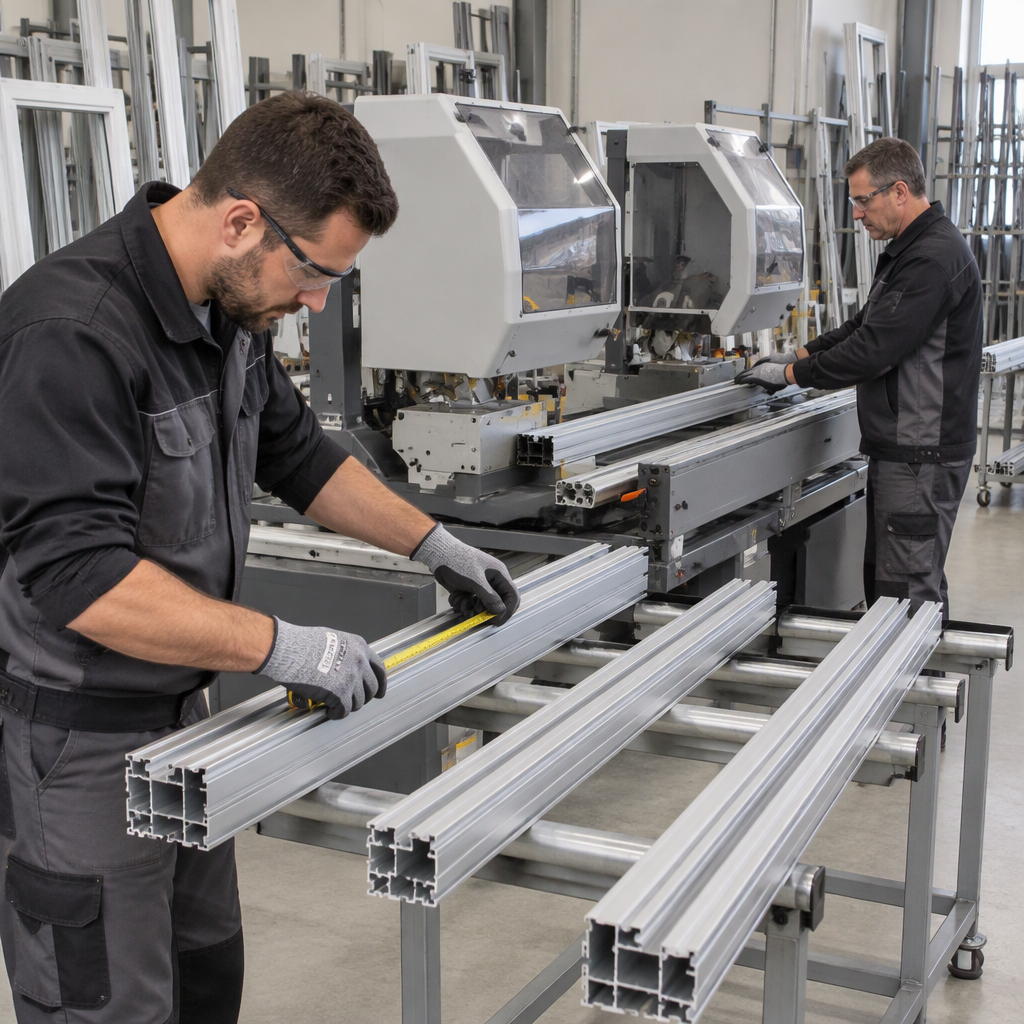
Aluminum window profiles being measured near a double-head saw in a clean workshop

When a double-head saw fits the window-profile process

A double-head saw is worth evaluating when your factory repeatedly cuts aluminum window or door profiles to controlled finished lengths and angles, especially where both profile ends must be planned together before assembly.

Good candidate applications

  • Repeated frame, sash, mullion, or similar profile cuts where the left and right ends must match the order drawing.
  • Production that needs a defined cutting-length range, angle pattern, and support method before the supplier can size the machine.
  • Factories that want purchasing, process engineering, and maintenance to agree on utilities, guarding documents, and service access before shortlisting.

Cases to check carefully

  • Highly mixed one-off work where a simpler saw, manual measuring method, or existing machining cell may be more economical.
  • Oversize or unusual profiles where the supplier must confirm whether the section can be clamped and supported without deformation.
  • Projects where the required accuracy is not yet separated from incoming extrusion tolerances and downstream assembly tolerance.

Do not turn a catalog phrase such as “digital display,” “CNC,” or “precision” into a purchasing specification by itself. Ask the supplier to state the measurable cutting envelope, angle settings, repeatability or accuracy basis, fixture assumptions, and test method that apply to the quoted model.

Profile and cut data to confirm before asking for a quotation

Before sending an RFQ, give suppliers the actual profile drawings, finished cut lengths, angle combinations, batch mix, edge-quality expectations, and site constraints so they can quote a machine configuration instead of a generic saw.

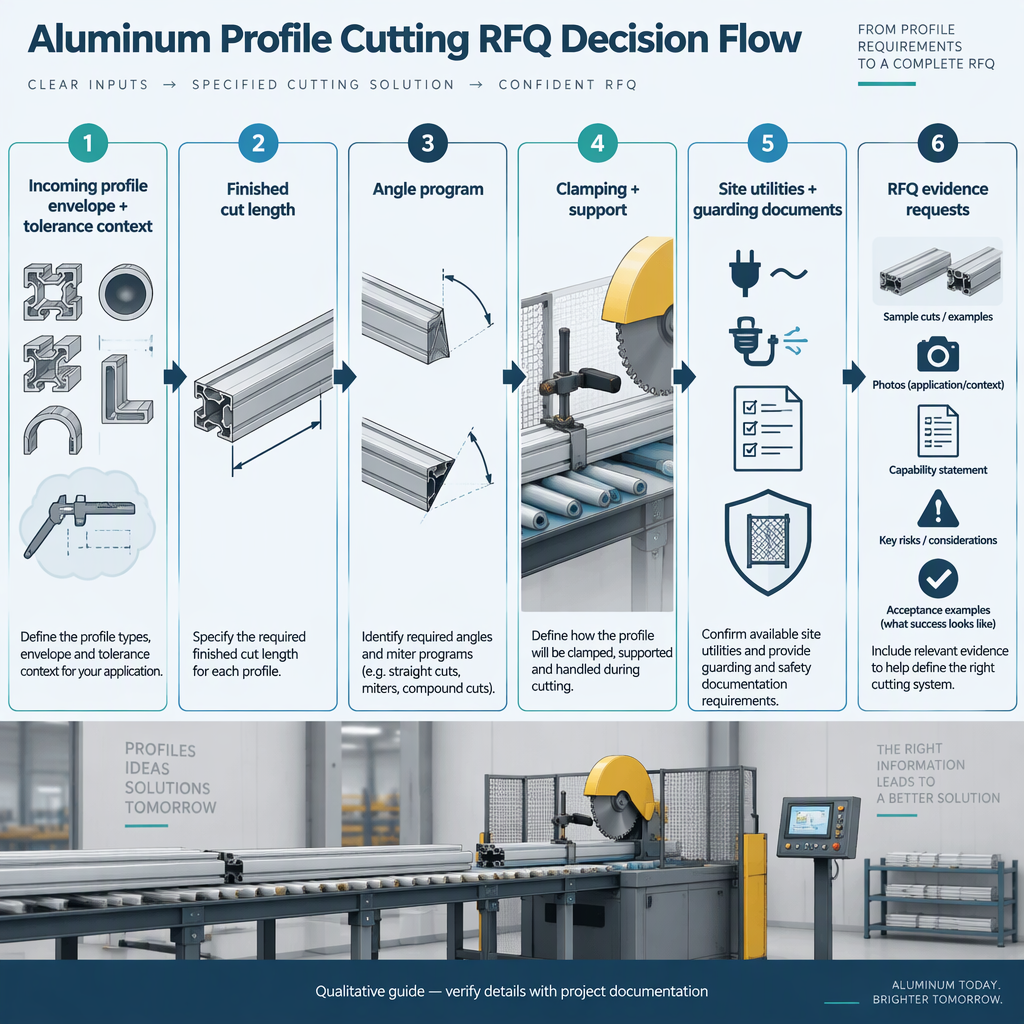
Decision flow from profile envelope and tolerance context to saw RFQ requirements
RFQ input Why it matters What to send
Profile envelope and circumscribing-circle context EN 755-9 addresses dimensional and form tolerances for aluminium extruded profiles within its stated scope; it helps frame incoming-profile discussions, not saw performance. Profile drawings, wall thicknesses, maximum outside dimensions, alloy/temper if relevant to your process, and any incoming inspection limits.
Finished cut length range The supplier needs the shortest and longest finished parts to judge machine bed length, head travel, supports, and measuring method. Minimum and maximum finished lengths, typical order lengths, and examples of awkward or low-volume parts.
Angle program Window and door work may involve straight cuts, mitres, and repeated left/right combinations that affect head positioning and setup method. Required angles, whether angles change often, and representative drawings for each frame family.
Clamping and support Thin-wall or decorative profiles can be damaged if clamping force, contact points, or supports are unsuitable. Profile samples or drawings, visible-surface requirements, protective film requirements, and orientation during cutting.
Downstream assembly requirement The cut part must fit the next operation, not just pass a saw-side measurement. Corner-joining method, gasket or hardware interfaces, drainage or machining steps after cutting, and the inspection gauge used in your factory.
  • List the profiles by family rather than sending only the largest section.
  • Mark visible faces and surfaces where burrs, scratches, or deformation are unacceptable.
  • State whether the saw must integrate with manual measuring, barcode/order data, or another production system.
  • Ask whether the quoted configuration changes when cutting aluminum profiles versus other materials.

How to separate profile tolerances from saw accuracy claims

Keep incoming extrusion tolerances, saw cutting accuracy, and finished-window assembly tolerance in separate lines of the specification so one document is not used to prove a different part of the process.

The standards-body page for NEN-EN 755-9:2016 states that the standard covers tolerances on dimensions and form for aluminium and aluminium alloy extruded profiles, with cross sections contained within a circumscribing circle not greater than 800 mm, for general engineering applications only; the page marks this edition as current.

That profile-tolerance reference should not be read as a promise that any particular saw will achieve a specific cut length, angle, surface finish, or assembly result. For the saw quotation, ask for the machine maker’s own test conditions, workpiece assumptions, measuring method, and acceptance criteria.

A practical specification can use three layers: incoming profile inspection, saw-side cut inspection, and assembled-frame inspection. If a supplier quotes a cutting-accuracy value, ask whether it applies to a single cut, repeated batch production, a specific profile geometry, a defined blade, and a defined clamping condition. If your factory uses customer-specific gauges, include those gauges in the acceptance conversation before purchase.

Installation, guarding, chips, and maintenance questions to ask

Ask installation and safety questions before ordering, because the best saw choice depends on the factory’s power, air supply, extraction or chip-removal method, guarding expectations, operator access, and maintenance responsibility.

  • Request the machine layout, footprint, loading direction, discharge direction, and space needed for long profiles.
  • Ask for electrical and pneumatic requirements, including connection points and any site preparation the buyer must complete.
  • Request guarding, emergency-stop, interlock, and operator-access information for the destination market, and confirm applicable local requirements with the responsible safety or building authority.
  • Ask how chips, offcuts, and dust are handled in normal operation, and what extraction or cleaning equipment is expected from the buyer.
  • Ask which routine maintenance tasks are operator-level tasks and which require trained service personnel.
  • Before any manual access to blades, clamps, guards, chip trays, or cleaning areas, require operators to switch off the machine, disconnect electrical power, isolate the pneumatic supply where fitted, and follow the model manual’s permitted access steps.

Do not ask a supplier for “compliance” in the abstract. Ask for the exact documents that matter in your market: declaration or conformity documents where applicable, guarding drawings, electrical documentation, pneumatic diagrams, installation manual, maintenance manual, spare-parts list, and training requirements.

How to evaluate supplier evidence before shortlisting

Use supplier websites to confirm identity and product-category relevance, then require model-specific documents before relying on cutting capacity, accuracy, safety, or production claims.

  • The supplier’s first-party homepage identifies the company as Shandong Eworld Machine Co., Ltd. and presents navigation for glass processing equipment and door/window processing equipment, including Aluminum Window machine entries and double-head cutting saw or miter saw product names.
  • Ask for the exact model quotation sheet, not only a category page or marketing title.
  • Request cutting-length range, angle capability, blade information, motor and control configuration, clamps, supports, utilities, and included options in writing.
  • Ask what profile samples or drawings the supplier needs before confirming the configuration.
  • Separate supplier identity, product availability, technical capability, and after-sales scope into different checklist items.
  • Do not treat certificates, rankings, country counts, or customer claims as purchase evidence unless the supplier provides current documents that apply to the quoted entity, product, and destination market.

RFQ checklist for a double-head saw

A strong RFQ for double head saw aluminum profiles gives the supplier enough application data to confirm fit, state exclusions, and quote the right accessories before commercial negotiation starts.

  • Company and factory location, destination market, and preferred installation timing.
  • Profile drawings, profile samples if available, visible-face requirements, and maximum profile envelope.
  • Minimum, maximum, and common finished cut lengths.
  • Required angle positions, angle-change frequency, and examples of frame drawings.
  • Expected edge quality, burr limits, scratch limits, and cleaning requirements after cutting.
  • Daily mix or batch style expressed as part families and order variation, not unsupported productivity promises.
  • Available floor space, loading side, discharge side, power, air supply, and chip-handling plan.
  • Required supplier documents: quotation sheet, layout, manuals, safety information, electrical and pneumatic data, spare-parts list, and acceptance-test method.
  • Incoming profile-tolerance references, such as EN 755-9 where applicable to the profile type, kept separate from the saw maker’s own accuracy claim.

Conclusion

The right double-head saw specification starts with the workpiece and the factory process, not with a product title.

  • Define the aluminum profile envelope, cut lengths, angle program, and visible-surface requirements first.
  • Separate incoming extrusion tolerances from saw cutting accuracy and final assembly tolerance.
  • Ask for installation, guarding, chip-handling, energy-isolation, and maintenance documents before purchase.
  • Use first-party supplier pages to confirm identity and category relevance, then require model-level documentation for the quoted saw.

FAQs about specifying a double-head saw for aluminum profiles

These questions help procurement and process teams turn a general saw search into a controlled RFQ.

When should a window factory consider a double-head saw?

Consider it when repeated profile work requires planned finished lengths and end angles at both sides of the part. If work is occasional, highly variable, or already handled by another process, compare the total setup, support, and inspection burden before buying.

What profile data should be sent with the RFQ?

Send drawings, maximum profile envelope, wall thickness, visible faces, finished cut lengths, angle requirements, and representative part families. Add samples when profile shape or surface sensitivity may affect clamping.

Does EN 755-9 define saw cutting accuracy?

No. EN 755-9 concerns dimensional and form tolerances for aluminium and aluminium alloy extruded profiles within its stated scope; it does not prove the cutting accuracy of a double-head saw.

How should edge quality be specified?

Describe the acceptable burr condition, visible-face scratch limits, cleanliness before assembly, and the inspection method your factory will use. If downstream corner joining is sensitive, include that interface in the acceptance discussion.

Which safety documents should be requested?

Ask for the installation manual, operation manual, guarding and emergency-stop information, electrical and pneumatic documentation, maintenance instructions, and any destination-market conformity documents that apply to the quoted machine.

What should operators do before clearing chips or cleaning?

Before manual access to any blade area, clamp area, guard, chip tray, or cleaning point, operators should switch off the machine, disconnect electrical power, isolate pneumatic supply where fitted, and follow only the access steps allowed in the model manual.

How can buyers avoid over-relying on product-page claims?

Use product pages for initial screening, then request the exact model specification, configuration list, acceptance method, and service scope. Keep marketing claims separate from contractual purchase requirements.

What can be confirmed from the readable Eworld homepage?

The supplier’s first-party homepage supports the English company identity Shandong Eworld Machine Co., Ltd. and shows glass processing and door/window processing equipment navigation with aluminum window machine and double-head cutting saw or miter saw product names; it does not by itself verify model-level double-head saw specifications.

Quick Link

Product Category

More Product

Contact Us

Copyright © 2025 Shandong Eworld Machine Co., Ltd. All Rights Reserved.| Sitemap| Privacy Policy