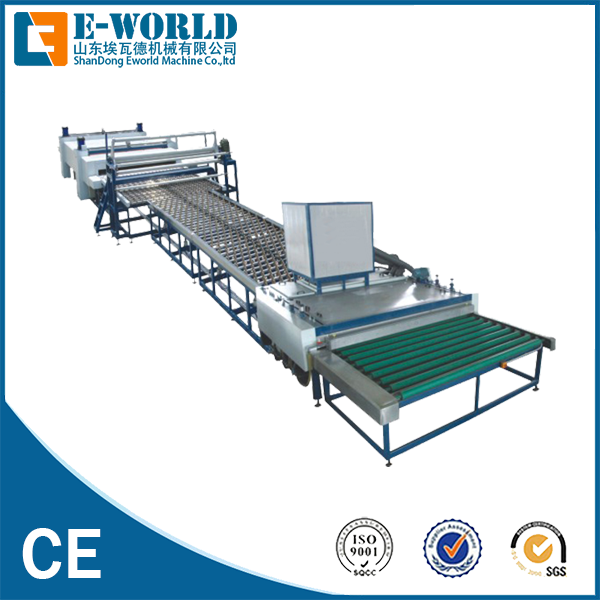
The Eworld WL2500 PVB laminated glass production line combines glass washing and drying, glass assembly, roller preheating and pre-pressing, and autoclave curing. The washer and pre-press are both listed for glass up to 2,500 mm wide. The size of the finished laminate also depends on the assembly equipment, transfer stations and selected autoclave.
Send us your glass sizes, ply thicknesses, PVB interlayer specifications and output target. We can review the equipment and utilities required for your line.
WL2500
Eworld
| Availability: | |
|---|---|
| Quantity: | |
The washer-dryer adjusts the height of the upper rubber rollers, brush rollers and air knives according to glass thickness. It has three pairs of brush rollers, with separate motors for the upper and lower brushes. Two pairs of stainless steel air knives dry the glass. The blower is fitted with an intake filter and acoustic insulation.
The washing and drying sections can be raised by 400 mm for cleaning and maintenance. The washing section uses stainless steel for metal parts that contact water, PVC water pipes and a recirculating water supply with mains-water replenishment.
Washer-Dryer Parameter | Specification |
|---|---|
Maximum glass width | 2,500 mm |
Minimum glass size | 420 × 350 mm |
Glass thickness | 3–25 mm, automatic adjustment |
Glass conveying speed | 0.5–4 m/min, variable-frequency control |
Roller table height | 810 mm |
Overall dimensions | 6,300 × 3,000 × 1,650 mm |
Total power | 39 kW |
Electrical supply | 380 VAC, 50 Hz |
Weight | 3,000 kg |
The traveling vacuum lifter combines a vacuum gripping system with a travel mechanism, pneumatic lifting and lowering, and operator controls. The original specification lists positioning accuracy of ±1 mm. The transition conveyor uses variable-frequency speed control to transfer glass between stations.
Parameter | Traveling Vacuum Lifter | Transition Conveyor |
|---|---|---|
Travel or conveying speed | 4 m/min | 0.25–5 m/min |
Listed glass size | 3,600 × 2,500 mm | Confirm for the selected layout |
Maximum lifting capacity | 1,200 kg | — |
Motor power | 0.37 kW | 1.1 kW |
Electrical supply | 380 VAC, 50 Hz | 380 VAC, 50 Hz |
Air pressure | 0.5–0.8 MPa | 0.5–0.8 MPa |
Listed air flow | 6.3 L/min | — |
Overall dimensions | 2,500 × 1,500 × 1,700 mm | 2,500 × 1,600 × 810 mm |
Equipment weight | 1,200 kg | 1,100 kg |
The PVB film unit holds up to three rolls and lists a 0.75 kW motor for roll positioning. Share your film widths and roll specifications so we can confirm the layup configuration and identify which steps are motorized and which are manual.
PVB Film Unit Parameter | Specification |
|---|---|
Film roll capacity | 3 rolls |
Listed positioning motor power | 0.75 kW |
Roller table height | 860 mm |
Overall dimensions | 2,000 × 3,920 × 2,400 mm |
Weight | 680 kg |
The roller press takes the assembled glass through initial pressing, infrared heating, final pressing and unloading. Its PLC touchscreen supports one-button start and automatic glass thickness detection and adjustment. Pressing pressure can be set from 0 to 0.6 MPa according to the glass thickness and area.
The heating unit has two sections with 60 infrared heating elements and stainless steel reflector panels. The heated chamber has insulation protected by galvanized sheet metal. The press uses heat-resistant rubber rollers and a gearbox housing made from 10 mm steel plate.
Pre-Press Parameter | Specification |
|---|---|
Maximum glass width | 2,500 mm |
Minimum glass width | 300 mm |
Processed glass thickness | 4–65 mm |
Adjustable pressing pressure | 0–0.6 MPa |
Roller table height | 860 mm |
Conveyor speed control | Variable-frequency control |
Listed total power | 63 kW |
Listed heating power | 62 kW |
Listed transmission power | 1.1 kW |
Electrical supply | 380 VAC, 50 Hz |
Weight | 4,500 kg |
The infrared autoclave completes the lamination cycle under heat and pressure after roller pre-pressing. The equipment range covers flat and curved laminates for architectural, automotive and multilayer protective glazing. Share the finished glass dimensions, laminate construction and rack layout so we can review the vessel size and usable loading space.
Listed Autoclave Size | Listed Installed Power |
|---|---|
Ø2,650 × 5,500 mm | 86 kW |
Ø2,650 × 6,000 mm | 92 kW |
Ø2,850 × 6,000 mm | 102 kW |
Ø3,000 × 8,000 mm | 144 kW |
The autoclave design combines infrared heating, internal air circulation and PLC touchscreen control. The cooling system uses galvanized finned tubes. The vessel door assembly includes a forged steel flange. Request the operating pressure, temperature profile, usable chamber dimensions and documentation for the vessel included in your quote.
The line covers four main stages: washing and drying, glass assembly and PVB layup, preheating and roller pre-pressing, and autoclave curing. Ask us to itemize the loading equipment, vacuum lifter, transfer stations, autoclave cart and any other equipment required for your layout.
The washer and pre-press each list a maximum glass width of 2,500 mm. The washer handles glass 3–25 mm thick, while the pre-press lists a processed thickness of 4–65 mm. Send us the size and thickness of each glass ply and of the assembled laminate so we can check compatibility across the line.
The film unit holds three rolls. Its specification lists a 0.75 kW positioning motor. Share your roll widths and layup requirements so we can confirm the controls and manual steps for the quoted unit.
Start with the largest finished laminate, the loading rack dimensions and the planned batch size. We can review chamber clearance, rack spacing and cycle requirements for the selected autoclave.
Send your minimum and maximum glass sizes, ply thicknesses, laminate build-up, PVB film specifications, target output, workshop layout and available utilities. Include the delivery destination and any installation or training needs so we can define the equipment and service scope.