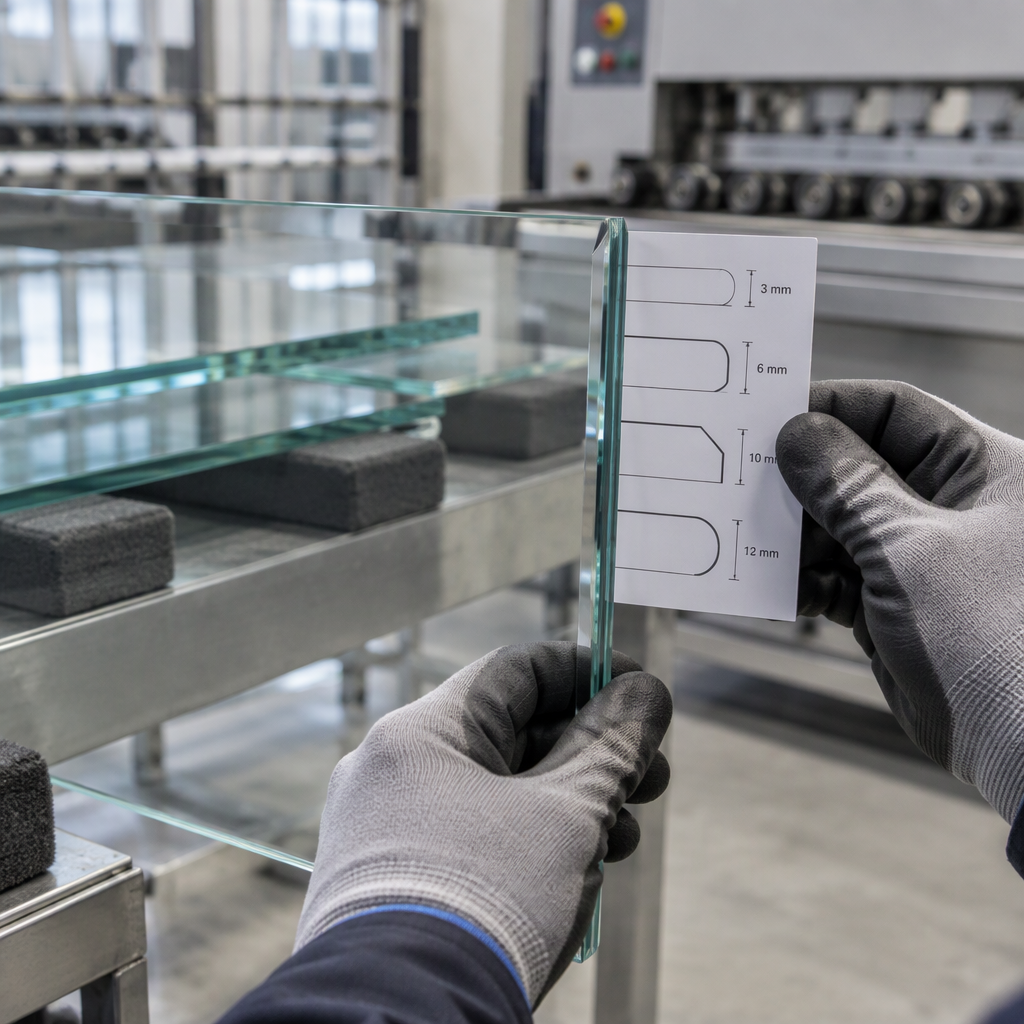
Choose the edge before the machine: list every edge, the profile it must carry, and your panel size range, then match that list to a machine category. Fix quote data, safety duties and acceptance criteria before comparing offers.
Which Edge Profile Do You Need Before Choosing a Glass Edging Machine?
Start from the drawing: every edge, the profile it carries, and your panel size range.
Edge work and the machine category to ask about | Edge work you need | What to mark on the drawing | Machine category to ask about |
| Polished straight edge, one or both long sides | Which edges, panel thickness, finish expected | Straight-line edging and polishing machine; straight-line double edge grinding machine for both long edges |
| Angled (beveled) edge | Bevel width and angle, and where it runs | Beveling edging machine |
| All four sides of a rectangular panel | Which sides are seamed and how corners meet | Four-side glass seaming machine; four-side turnable edging machine |
| Shaped or irregular outline | Outline drawing, tightest curve, edge condition | Semi-automatic glass shape edger; CNC glass working centre for irregular shaped edging |
| Small parts or touch-up work | How often it comes up and where it is done | Small or portable edge polishing machine |
Two limits belong here: PVC and aluminium window machines and glass washing machines are separate lines, so specify post-edge cleaning separately and treat no category name as proof of capacity or finish.
Which Glass Edging Machine Configuration Fits Your Panel Sizes and Shapes?
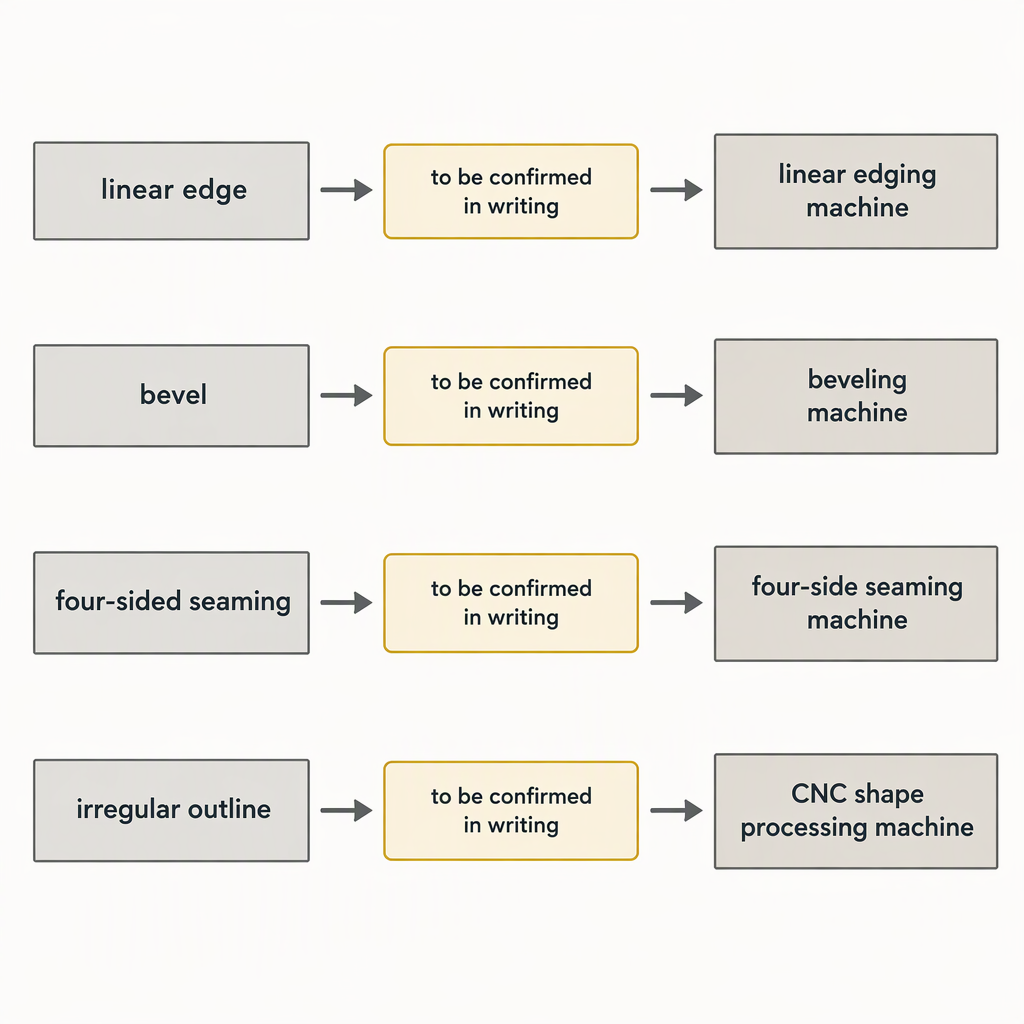
Match the machine to the edge: straight edges to a straight-line edging and polishing machine, bevels to a beveling edging machine, four sides to a seaming or four-side machine, and shaped outlines to a shape edger or CNC working centre.
![Diagram linking four edge-work types, linear edge, bevel, four-sided seaming and irregular outline, to the matching machine categories, each row carrying an empty field for capacity to be confirmed in writing]()
Straight-line and double-edge route
- Edge work: continuous straight edges on a straight-line edging and polishing machine, or a straight-line double edge grinding machine when both long edges run together.
- Panel geometry: needs a straight reference edge along the full pass, so check your narrowest and longest panel against the stated limits.
- Ask in writing: thickness range, panel size limits, profiles carried, tooling set, and the setting sheet for each of your edges.
Shaped and CNC route
- Edge work: shaped and irregular outlines on a semi-automatic glass shape edger or a CNC glass working centre for irregular shaped edging.
- Panel geometry: driven by the outline, so state the tightest curve and the smallest panel in your range.
- Ask in writing: working envelope, how a new outline is set up and proved out, tooling support, and who trains your setters.
Where four-sided seaming and shaped outlines share a shift, expect two machines or a written list of passes.
What Data Must Be Fixed Before You Request an Edging Machine Quote?
Send one data pack: panel envelope, glass thickness and type, every edge and profile, output per shift, line position, utilities and floor space.
Quote data, why it matters, and what must come back in writing | Data to fix | Why it changes the offer | What the supplier must return in writing |
| Smallest and largest panel (length by height, in millimetres) | Sets the working size and how the panel is supported and moved | Model panel size limits, measured the way you measure |
| Thickness range and glass types, including laminated or coated glass | Sets tooling, hold-down and the passes needed | Accepted thickness range, and any restriction on the glass you run |
| Every edge and profile: flat polish, bevel, seam or shape | Decides how many operations are needed, and whether one machine covers them | Which of your profiles the proposed machine produces, and which need another operation |
| Output per shift and the batch pattern | Decides the machine category and the loading pattern, not just motor size | The output expected on your edge work, with the basis for that figure stated |
| Line position, and whether the next step washes the glass | Decides loading and unloading, and whether a washer joins the line | Whether washing after edging is included, and where it sits in the sequence |
| Utilities, floor space and floor condition | Decides the installation layout and what you must prepare | Utility requirements, footprint, anchor points and your preparation list |
- Panel drawings with the required profile marked on each edge.
- Smallest and largest panel, and the thickness range, in millimetres.
- Glass types you run, including laminated, coated or printed glass.
- Output per shift, batch sizes and how often profiles change.
- The exact line position, with the power, air and floor conditions there.
- Your acceptance criteria: who inspects, at which stage, and by which method.
How Do You Verify a Supplier's Stated Range and Capability?
Treat a catalogue entry as the start of the conversation, not proof: the model data sheet, the manual, the tooling list and a written edge statement.
- Data sheet for the exact model quoted: panel size limits, thickness range, profiles, speed settings and installed power.
- Operation and maintenance manual in a language your operators read, including the guarding, isolation and access instructions supplied with the machine.
- Tooling and consumables list, with the supplier's lead times for each item.
- Electrical, air and floor requirements, plus the anchoring and installation plan.
- Training plan: who trains your operators and setters, on which edges, and for how long.
- A written statement of what will be demonstrated on your own glass, and which edges are excluded from it.
What a supplier publishes describes a product range, not your machine's performance. The glass edge machine range published by Shandong Eworld Machine Co., Ltd. lists straight-line edging and polishing, beveling, four-side seaming, shape edging, double-edge grinding and CNC edging for irregular outlines as separate categories, and the company's own description states that it began in 2014 and manufactures glass processing equipment, window and door equipment and CNC equipment. Range and company background help you shortlist; the model data sheet and a written edge list are what you buy against.
What Guarding, PPE and Noise Requirements Belong in the Specification?
In a US general-industry workplace, buy to these OSHA duties: guarding at the point of operation and nip points with secure anchoring (29 CFR 1910.212), and protective equipment selected for the hazards found and certified in writing (29 CFR 1910.132). Elsewhere, confirm local rules.
The guarding duty is set out in 29 CFR 1910.212: guards must protect the operator at the point of operation and at nip points, be affixed to the machine, and not create a hazard; a fixed machine must be anchored.
Under 29 CFR 1910.132, protective equipment must be provided where processes or mechanical irritants can cause injury, and the employer must assess the hazards, select suitable equipment and certify it in writing.
Noise depends on the machine and the installation: ask the supplier for its model noise data and check your safety authority's limits. Before cleaning, clearing a blockage or changing a tool, switch the machine off and disconnect it from its power source, then follow the manual's access steps.
- Guarding: which guards cover the point of operation and the nip points, and how they are fixed.
- Anchoring: the anchor points and the floor preparation the machine needs.
- Isolation: how the machine is switched off and disconnected from its power source before any manual access.
- PPE: which eye, hand, hearing and respiratory protection the hazard assessment calls for, and who signs the certification.
- Training: which manual procedures operators are trained against, and when.
How Should Edge Quality Be Accepted After Installation?
Agree the acceptance criteria before the order, run them on your own glass with your operators present, and record the settings and results. Accept the machine against those written criteria, not against a demonstration on glass the supplier brings.
- Write the criteria before you buy: which edges and profiles are covered, how many panels of each, who inspects, and the method and viewing conditions used.
- Keep an approved reference panel for each profile, in the same glass type and thickness as production, signed by both sides.
- Run every profile on your own glass with your operators at the controls, and record the settings and measured results in the handover record.
- Inspect each agreed profile against the reference and the written criteria, listing every deviation with the panel it came from.
- Agree the remedy and the re-check date for each deviation in writing before the final payment milestone.
- Hand over the manual, tooling and spare parts list, training record and a named service contact, and release final acceptance only when the written criteria are met on production glass.
Set your own pass and fail limits for chips, finish and haze in writing, and test them on the thinnest and thickest glass you run. Manual access waits until the machine is switched off and disconnected from its power source.
Conclusion: The Selection Sequence in One Decision Path
Work the sequence in order: edge profiles and panel envelope first, then the machine category that covers them, then the data pack that makes quotes comparable, then the safety duties that apply where the machine will run, and finally the acceptance criteria you will sign against.
Each step narrows the next. A profile list turns into a category, a category into a data pack, a data pack into comparable offers, and written acceptance criteria turn a demonstration into a machine you can measure.
Next step: send the data pack to each shortlisted supplier and ask for the model data sheet, the guarding and isolation information, and a written statement of which of your edge profiles the proposed machine will produce.
Frequently Asked Questions
The questions buyers ask most often when a glass or window factory specifies its next edging machine.
Should I choose the edge profile or the machine first?
The edge profile first. Every edge that needs work, the profile it must carry, and the smallest and largest panel you run point to a machine category before any specification is compared.
Can one machine produce straight edges, bevels and four-sided seaming?
Beveling, four-side seaming and straight-line edging are offered as separate machine categories, so do not assume one quotation covers them all. Ask which of your edges the proposed machine produces and which need a second machine or a second pass.
Can a straight-line edger run shaped or irregular panels?
Straight-line machines work on straight edges; shaped work is offered through a semi-automatic glass shape edger and a CNC glass working centre for irregular shaped edging. Confirm the outlines and the tightest curve the quoted model can run.
What should a quote request contain?
Panel drawings with the profile marked on each edge, the smallest and largest panel and the thickness range, glass types, output per shift, line position, utilities and floor space, plus your acceptance criteria.
Should guarding and PPE duties appear in the machine specification?
In a US general-industry workplace, 29 CFR 1910.212 requires guarding at the point of operation and at nip points, guards fixed to the machine where possible, and secure anchoring. 29 CFR 1910.132 adds a hazard assessment, equipment selected for the hazards found, and a written certification of that assessment. If the machine runs elsewhere, confirm the equivalent duties with your local authority.
How do I check a supplier's catalogue claims before ordering?
A catalogue shows which categories a supplier offers. For the machine itself, ask for the model data sheet, the manual, the tooling list, and a written statement of which of your edges it will produce on your glass.