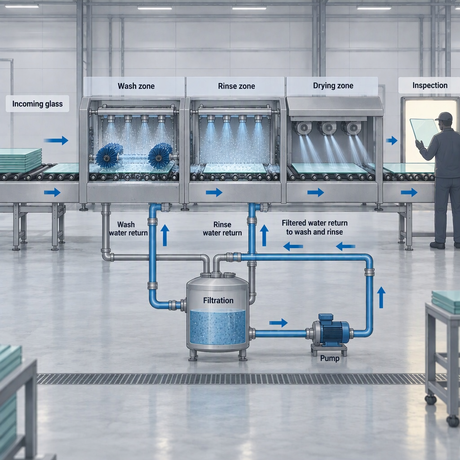
For glass and window or door factories, water quality is a process input before equipment selection. Treatment, recirculation, filtration, residue control, final rinse practice, and drying can influence visible finish, so define the glass route and water conditions before comparing washer quotations.
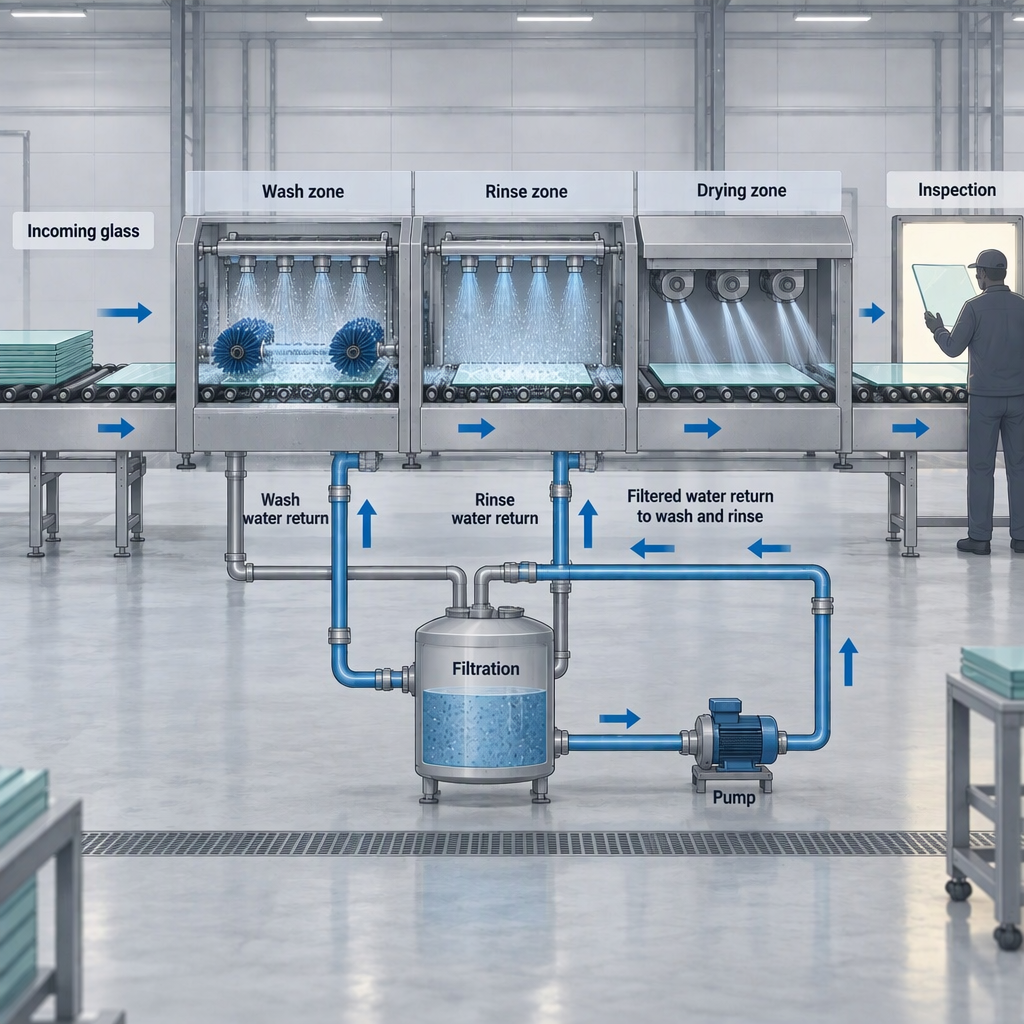
How water quality connects glass washing to surface finish
Water quality connects to surface finish because rinse water can carry or leave residues, while high-quality rinse water is used to support cleaner finish, quality, and durability in glass-industry rinsing applications.
In a glass washing discussion, water is not only a utility connection. It is part of the process condition that reaches the glass after cutting, edge work, handling, and washing. A rinse-water example for the glass industry identifies cutting fluid, residue, and particles as materials that may need to be removed from water before reuse or final rinsing.
Focus on how the line moves from soil removal to rinsing, drying, and inspection. Discuss water treatment and filtration with glass size, edge condition, downstream use, and the acceptance method for visible appearance.
Water-quality variables to confirm before equipment selection
Before selecting glass washing equipment, confirm the water source, treatment method, recirculation approach, filtration plan, final rinse expectations, and monitoring method.
A glass-industry rinse-water example combines softening, reverse osmosis, recirculation, and dual gravel and activated-carbon filtration. Do not copy that combination as a universal specification; use it as a prompt for RFQ process questions beyond machine width or price.
| Variable to discuss | Why it matters for selection | Buyer action before quotation |
|---|---|---|
| Incoming water condition | The treatment needed for rinse water depends on the starting water condition and the finish expectation. | Share available water-quality data and ask what additional measurements are needed before configuration. |
| Treatment method | Softening and reverse osmosis appear in a glass rinse-water treatment example as part of producing demineralised rinse water. | State whether the factory already uses softening, reverse osmosis, deionized water, filtration, or another treatment system. |
| Recirculation and filtration | Recirculated rinse water may require filtration to remove cutting fluid, residues, and particles before reuse. | Ask which stages recirculate water, which filters are used, and how the condition is checked over time. |
| Final rinse quality | The final wet stage is closely tied to what remains before drying and visual inspection. | Ask the supplier to define final rinse requirements for the actual glass route and inspection target. |
| Conductivity target | One glass-industry rinse-water case used a conductivity range of 10–30 µS/cm, but that figure is case-specific. | Use supplier-recommended values for the project rather than applying one case value to every line. |
Why final rinse and drying deserve separate attention
Final rinse and drying deserve separate attention because the rinse condition, remaining residues, and water removal step shape the surface that reaches inspection.
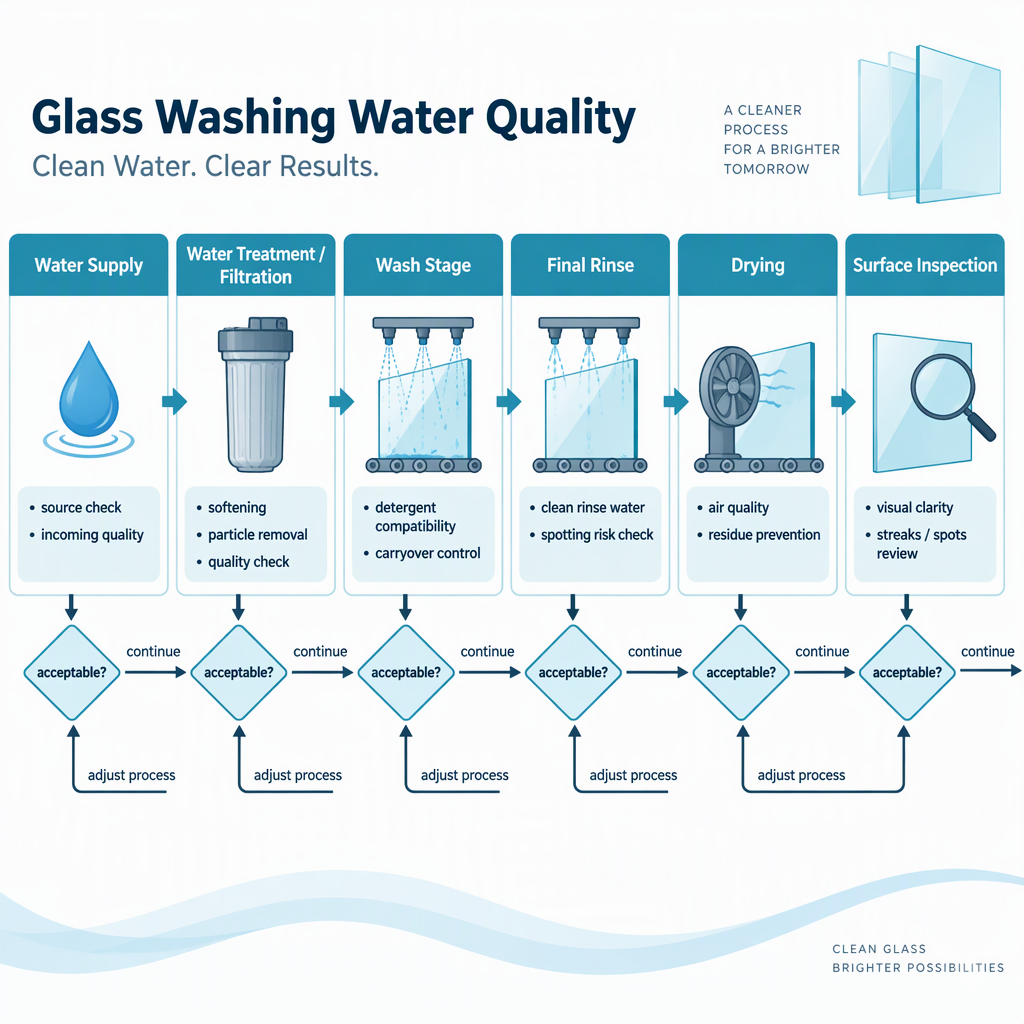
A washing section may remove heavy contamination, while the final rinse is closer to the surface seen after drying. In the glass-industry rinse-water example, demineralised water, reverse osmosis, filtration, and residue removal are linked process choices.
- Map the route from cutting or edge processing to washing, rinsing, drying, inspection, and the next operation.
- Identify the soil sources that matter for the project, including cutting fluid, edge residue, particles, dust, or handling marks.
- Separate wash-water, intermediate-rinse, and final-rinse questions so recycled water is not confused with final rinse expectations.
- Ask how filtration or treatment is applied when water is reused or recirculated through the washing process.
- Agree how the finished surface will be inspected after drying and how any rinse-water settings will be recorded during trials.
RFQ data to prepare for a glass washing project
A strong RFQ gives suppliers the glass route, soil source, water condition, treatment plan, rinse expectation, drying requirement, and inspection method before the quotation is compared.
Glass and window or door factories may wash glass after cutting, edging, drilling, storage, or handling. Because rinse-water treatment and residue control are process inputs, describe the actual route instead of assuming one washer setup fits every finish expectation.
- Glass size range, thickness range, maximum weight, and whether mixed batches must run through the same washer.
- Edge condition before washing, such as cut, ground, polished, drilled, notched, or shaped glass.
- Soil sources before washing, including cutting fluid, edge residue, particles, dust, fingerprints, or storage contamination.
- Current water source and any existing treatment, filtration, softening, reverse-osmosis, or deionized-water system.
- Whether water will be recirculated, where filtration is expected, and which rinse stages require fresher or treated water.
- Downstream process after washing, such as inspection, insulating-glass assembly, lamination preparation, coating-related handling, or direct shipment.
- Available floor space, drainage, water supply, power, compressed air, and safe access for operation and permitted maintenance.
- Surface appearance acceptance method, including who inspects the glass, where inspection occurs, and what defects trigger rework.
Limits: what water-quality guidance cannot prove by itself
Water-quality guidance helps buyers ask better equipment-selection questions, but it does not prove a supplier’s machine capability, production capacity, or project-specific surface-finish result.
Separate general rinse-water principles from supplier-specific claims. A commercial rinse-water example can show that demineralised water, softening, reverse osmosis, filtration, recirculation, and conductivity may matter in glass washing; it cannot set universal limits for every washer, factory, glass type, or finish requirement.
One glass-industry rinse-water case describes softening, reverse osmosis, recirculation through dual gravel and activated-carbon filtration, removal of cutting fluid, residues, and particles, and a case-specific conductivity range of 10–30 µS/cm. Treat those details as a prompt for supplier questions, not as a universal purchasing specification.
Conclusion
Water quality should be handled as part of the glass washing specification before the machine layout, water treatment, and acceptance method are finalized.
Before requesting a quote, collect the glass route, edge condition, soil source, water source, treatment method, recirculation plan, final rinse expectation, drying requirement, inspection method, and safe access needs. Compare suppliers by how clearly they translate those inputs into a washing process and project limits.
FAQ
These questions help glass and window or door factories turn washing-water quality into a practical application-selection discussion.
Should water quality be discussed before choosing a glass washer?
Yes. Discuss water quality before finalizing the washer configuration because rinse-water treatment, filtration, recirculation, and residue control can affect the washing process and visible surface result.
Can one exact water specification fit every glass washing project?
No. One glass rinse-water case used 10–30 µS/cm conductivity, but that value is case-specific. Ask the supplier to recommend values for the actual glass type, water source, treatment system, and finish requirement.
Why ask separately about final rinse water?
The final rinse is close to drying and inspection. Buyers should understand whether final rinse water is treated, whether it is separated from earlier stages, and how residues or particles are controlled.
What if the factory already has water treatment equipment?
Describe the existing treatment system and ask whether it matches the washer’s rinse-water requirements, where treated water should be used, and how operators should monitor it.
Are spots or streaks always caused by water quality?
No. Water quality is an important process input, but buyers should also review residue sources, recirculation, filtration, drying, handling, maintenance, and the inspection method.
What documents should procurement request from suppliers?
Request written water-quality requirements, treatment recommendations, recirculation and filtration details, commissioning checks, operating limits, and an agreed method for judging washed-glass appearance.
What safety point matters when checking a washer manually?
Before manual access for inspection, cleaning, clearing, or adjustment, switch off the machine and disconnect the applicable power source. Then follow only the access steps allowed by the official manual.